Showing posts sorted by relevance for query tag to. Sort by date Show all posts

Bomb Rush Cyberfunk Review or: How I Learned to Stop Worrying and Love the Funk

Jet Set Radio (or as it was known in North America, Jet Grind Radio) came skating onto the scene in the year 2000. Developed by Sega's in-house studio Smilebit, the flagship Dreamcast release saw players enrol in the rollerblading GGs gang to claim their turf back from their rivals, one graffiti tag at a time, all whilst evading the clutches of the law. A platformer at heart, JSR was fun gameplay-wise, but what kept me and many others coming back for more was undoubtedly its revolutionary cel-shaded graphics, along with its premise, style and music - all a loving tribute to hip-hop and street culture. The exceptional soundtrack, the majority of which was composed by Hideki Naganuma, combined elements of hip-hop, J-pop, funk, electronic dance, rock, acid jazz, and trip-hop, and has been lauded by fans the world over to the point where it's almost taken on a life of its own outside of the game.

North American magazine ad for Jet Grind Radio

In the years following Jet Set Radio's release, Sega stopped making consoles and moved to being a third-party developer. Initially things were pretty good, with a wide range of their IPs receiving new titles or reboots, including Jet Set Radio, which received a beloved sequel/re-imagining on the original Xbox in the form of 2002's Jet Set Radio Future.

But, with series developers Smilebit closing their doors in 2004, and Sega's attention to any IP that wasn’t Sonic slowing to a drip feed over the following decade, the possibility of a new entry into the JSR series became less likely with each passing year. We did see a HD remaster during the seventh generation, which was cool, but the fully fledged third instalment many players have been waiting for just never happened.

The album cover for 2 Mello's "Memories of Tokyo-To"

During the series' absence, a cult community of fans slowly began to form around Jet Set Radio, with its art style and music finally being appreciated for how excellent it really is. A fan developed a whole website to stream JSR tunes 24/7, while artists like 2 Mello made entire albums in the style of the JSR sound. Many new indie titles like Umarangi Generation and Hover aimed to emulate that funky cel-shaded feeling we were sorely missing. Seeing this community of fans and creators blossoming around JSR really got me thinking... with the series' strongest suit undoubtedly being its aesthetic style and music, and with aspects such as the story and character's personalities taking a backseat (with perhaps the exception of DJ Professor K), it made me wonder: could someone else make Jet Set Radio? We'd witnessed it in the indie space for years, with titles like Bloodstained: Ritual of the Night, Shovel Knight and Cities: Skylines filling the void left behind by the neglect of bigger developers. For me, Jet Set Radio’s best asset is not that it was made by Sega. Sure, the genius minds of Dreamcast-era Sega gave it its best assets, but the fact that Jet Set Radio's winning formula has been abandoned for so long, that it hasn't had the chance to be developed further, to become bigger and better with the power of modern systems, to be re-introduced to a new generation of gamers, is criminal, frankly. As long as the right people were involved, Jet Set Radio could come back in style, even if it meant sacrificing the name.

Lethal League Blaze

The answer to my prayers came in 2020, when Dutch indie developer Team Reptile teased Bomb Rush Cyberfunk. Having previously worked on Lethal League, an excellent series of fighting games that feature cel-shading and character designs reminiscent of Jet Set Radio, and with the second game, Lethal League Blaze, even featuring a song from Hideki Naganuma, it was no surprise that Team Reptile were going to attempt a spiritual successor to Jet Set Radio for their next release. From their short teaser alone, I immediately knew they were the right people for the job. Bomb Rush Cyberfunk looked so much like a new Jet Set Radio game that I would've forgiven you for thinking it was made by Sega themselves. The teaser even featured a Naganuma track. It was finally happening!

Despite this, I still saw a fair amount of scepticism online. Some loyalists said they'd just wait for Sega's Jet Set Radio. Some even went as far as to accuse Team Reptile of "plagiarism". C'mon guys, it has been more than 20 years since Sega released an original entry into the Jet Set Radio series. To bastardise that famous lyric from John Lennon:

"All we are saying is, give Bomb Rush Cyberfunk a chance"

On the day it released, I bought Bomb Rush Cyberfunk for the Nintendo Switch, as that was the only console it was available for initially, and I don’t have a gaming PC, so that option was out. From the outset, the game's cel-shaded look, music and sound effects all felt familiar to me. It was great to jump back into that grinding and tagging gameplay I loved so much, to be transported right back to those special moments of playing the original JSR and Future for the first time. But Bomb Rush Cyberfunk is quick to remind you that while it remains incredibly faithful to its source material, it isn't completely derivative of it. Instead, Team Reptile are here to build and improve, which is exactly what I wanted to see from a spiritual successor to Jet Set Radio. I've always sung the praises of the gameplay refinements that Jet Set Radio Future introduced to the series, and Bomb Rush Cyberfunk is no different, picking up where that game left off but now with the benefit of twenty years of hindsight in its arsenal. Throughout this review, I will be calling back to JSR and Future many times to explain how BRC successfully builds on - or even improves - the formula, but please don't understand this as me disparaging the JSR series at all. Both Jet Set Radio and Jet Set Radio Future will forever remain two of my most favourite games of all time.

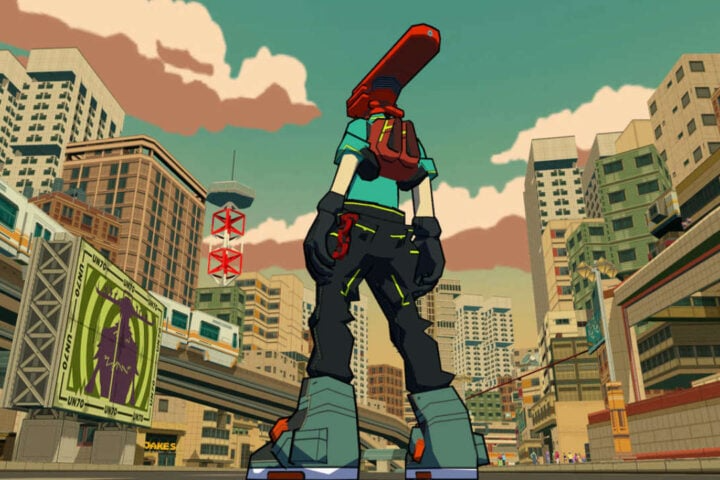
Bomb Rush Cyberfunk's plot, while still containing the appropriate dose of hip-hop and street culture references you'd expect, is crazy, and immediately more involved than either of the JSR games. Rather than functioning as stylish avatars for your rollerblading escapades, the main set of characters of the Bomb Rush crew have unique personalities and converse with each other in cutscenes, much of which is humorous and often eccentric. The main character, Red, has a purpose - to get his head, which was chopped clean off his shoulders in the game's prologue, back, while also looking to investigate the past of his replacement head (I said the plot was crazy, didn't I?).

The rival crews, still serving as your opponents throughout the game, also have more purpose in the plot, as Red and his crew not only look to defeat them to become "All City" (to claim all turf in the city), but also to gain information to aid in their hunt for Red's origins. While I won't spoil the plot here, all I'll say is the whole idea of Red being a character patched together from the body and head of two different characters, and the duality that brings, is one of the more refreshing plot ideas I've had the pleasure of experiencing in a video game as of late. There are plenty of surprising twists and turns you may not have been expecting from a game that many will be turning to primarily for its aesthetic qualities, and it is certainly refreshing to see.

Bomb Rush Cyberfunk's cast of characters are all varied in design and dripping with style, with their clothing combining the aesthetics and fashion of not only hip-hop and its b-boy subculture, but also the skate culture of the early 2000s, with some sci-fi flair thrown in for good measure. Characters like Red, with his crimson "cyberhead", and the angel-winged crash dummy Solace stand out as the coolest of the bunch, while story characters like the "oldheads" are more amusing, looking like caricatures of golden age hip-hoppers with their maroon tracksuits and over-sized Kangol-esque hats. One of them even has a cyberhead that looks suspiciously like the mask of the late MF DOOM. DJ Cyber's cold cybernetic mask and long stylised lab coat really set him apart as the menacing antagonist he is and the Dot EXE crew just look fresh as hell with their pool ball cyberheads and two stripe tracksuits. Team Reptile really knocked it out of the park when it came to matching the imaginative character design seen in the games BRC takes influence from, so much so that you will undoubtedly be searching around the game's city to track down more peeps to add to your posse.

Depending on how you look at it, one potential flaw of BRC's playable characters could be that none of them have any stats, meaning that your decision on who to play as solely comes down to how cool you think they look. Jet Set Radio did assign stats to each character, which meant there was a bit of strategy involved when making your choice of whom to tackle a particular level with, but I suppose ultimately it's probably better to be able to play as your favourite character without their weaker stats holding back your enjoyment, and it does feel great to be able to constantly switch between BRC's aesthetically pleasing cast of characters just 'cause.

Credit: JREEL on YouTube

So we've got a great storyline and some cool characters, but how's the gameplay?

The Dreamcast Legacy - BlazBlue: Cross Tag Battle

In a new series of articles (perhaps only a short-lived series, as I only have this and one other lined up), we will be exploring modern games that owe a debt to the blazing trails left by the games and developers of the bygone Dreamcast era. In this issue, we will be looking at the upcoming Arc System Works title BlazBlue: Cross Tag Battle, a new 2 vs. 2 tag-team fighting game coming soon to PS4, Switch, and Steam. Apart from the obvious correlations with similar Dreamcast heavyweight titles such as Marvel vs. Capcom 2 and the Capcom vs. SNK series, this new crossover beat-'em up shares a little more Dreamcast heritage than you may initially realise.


This summer I have been mostly playing..

Summer has been very long for me, about three months to be exact, and now it's almost coming to a close as I go back to University at the end of this month. This long time off, however, has given me plenty of time to get acquainted with my Dreamcast and buy new stuff for it. Here I list the top 3 games that I have been the most hooked on those unbearably hot summer days.


3: Puyo Puyo 4
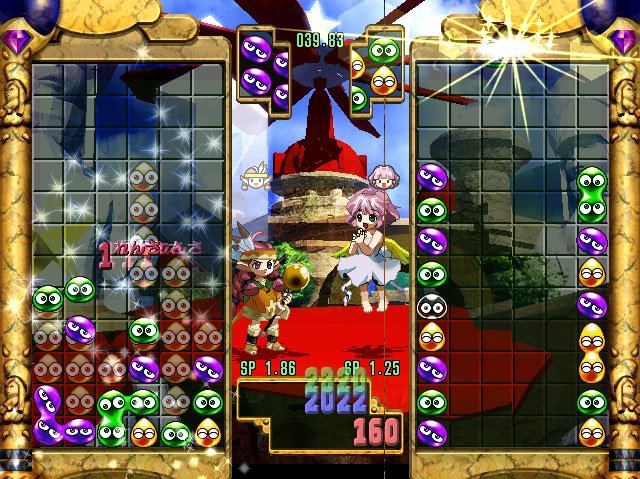
I completely forgot to write about this game here at the Blog, but here it is. Not to be confused with it's follow up Puyo Puyo Fever, which I did write about, this is the last in the series produced by it's original developers Compile, and one of the last to feature the original cast which included the heroine Arle, the green haired devil guy Satan, the tea-obsessed Skeleton-T, and that weird fish with human limbs that has a really long name. I grabbed it off Ebay for a tenner. Anyway, there are many reasons why this game turns out to be a lot better than fever was, despite the language barrier. For starters the graphics are not quite as eye-bleedingly colourful and he artwork is beautiful. Secondly, there are a lot more modes of game play to pick from here, including a endless mode that gives you a choice of 5 different sizes of Puyos from the teeny tiny to the screen-filling huge) and there's even a 4-player mode.

What's had me stuck into it mainly over the summer was the Story mode. While the story in Fever only took a day to complete, the one really long story mode in this took around a month. The fever feature in the follow up made the game a bit too easy, but in this game you get special moves instead, and as you go through the story more characters tag along with Arle, so you get to choose from different specials. Puyo 4 is far more tactical then any of he others I played, and it's all about getting good combos, and the timing of your specials (which you only get a limited few of). I would spend days on some levels later on, as the characters started to get rock hard.

The very final boss, a evil clone of Arle of some sort, has to be one of the most taxing challenges I've come across in a puzzle game. There are two Puyo blobs in the corners worth 500,000 points each, and if the CPU gets one of them, you have automatically lost as rows and rows of blocks fall down on you. If you hit one of the, however, the CPU has 5 shields to stop the blocks falling down for a minute each, and you don't have any specials to use at all! The only way to beat her, after days to trying, was to somehow get both of the 500K blobs AND prevent her from getting anywhere near her two! I got it in the end, and the satisfaction of finally beating the game was overwhelming, especially when I rarely beat games as hard as this one was. Phew.

2: Seaman
No, not that Seaman!
With months of time ahead of me, I decided to start up Seaman again at the start to make up for my poor first attempts at it, in which after a couple weeks I gave p and deleted it. This time, I was determined to get right to whatever kind of ending this game has, if it even had one. Playing it for five minutes every one or two days seemed to do the trick. The questions the miserable sod asks you are very varied, from the simple ("How old are you?"), to the personal ("Do you like yourself?") to the Sega-indorsed ("What is your favourite Dreamcast game?"). It's quite some time before the fishes start to evolve, but after a while (about a month), they start to grow legs, and once that stage of their evolution is sorted, one of them will ask you to help him push a big rock in the corner of the tank. getting him to do this makes the tanks water sink down into a small area, and turns the tank into a beach of some sort.

This Seaman you twat.
I won't spoil the rest of the game for you, as FatherKrsihna appaers to be playing through the game as well, but after almost 3 months of five minute or so sittings, there is an ending to this game, in which you dion't have to look after him anymore. You can, however, still go back to the file and check up on him, and see if he has evolved some more. It may not sound all to eventful, but trust me when I say this is one of the most bizarre yet interesting experiences I have had on the Dreamcast, and the only virtual pet game I've played with a real award to it. Who needs Nintendogs when you can have a real dog? Well, where can you get a real talking fish or frog? No where. Well worth the patience of playing it at the start to get to the later parts.

1: Sega Marine Fishing
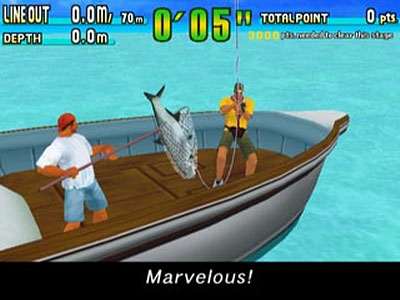
Yes, the most played game of the summer for me was a fishing game. Don't look at me like that! I've actually had this game for a long while from where I picked it up while in America, but didn't really want to play it until I got my mitts on a fishing controller, which I did just this year for 3 squid in a Gamestation. Playing this along side Sega Bass Fishing, I've come to the conclusion that this game is at least 10 times better than that one was. For starters, you have more than 1 type of fish to catch: you have around 20, including sharks, stingrays (No comment.) and all sorts of tropical type fishes. Also, while Bass Fishing was a port of a crusty old Model 3 game from 1997, Sega Marine Fishing was the latest from Sega's Naomi arcade line up and looks the bees knees.

Now I'm not in the slightest bit interested in fishing, but this game is a big exception. Instead of sitting around waiting for the miserable sods to bite, in this game you quite often have multiple fish fighting over your lure, and catching the buggers, thanks to the fishing controller, as always hella fun. The real reason I've been playing this game for the last few months almost religiously is because of the Original Mode. Here you get he choice of the Mini-Games, where you gain items, Free Fishing where you have no time limit and must catch fish to win these gained items, and the Aquarium where a lot of the items go, such as fish, ruins, submarines and even a UFO! Other items you can gain include more specialist lures to catch certain fish, new clothes for your crew (of very bad taste, I might add) and even a Labrador to bark away at the fish you catch. You can even eventually swap your boat for a raft, a wobbly plank of wood which appears to have nothing to move it with.

I've almost got to the end of this very long game now, as I've now gained all 266 items and now just need to win about 30 of them. The only problem is as you go along through the game you end up with less and less fish to catch: once you've caught a particular fish a few times, catching it again wins you nothing. It's now starting to get to he point where almost everything I catch I've already caught, and yet they still insist on biting, sometimes the same fish a few times in a row. Still, my Aquarium is almost full now (just one type of fish to go, I have everything else), so playing through this game is well worth the time. Completing the Arcade mode about 4 or 5 times also unlocks more levels to catch the last items on, such as Hammer-head Sharks. Judging from the reviews this game got, this is a real under rated gem in my opinion, and miles ahead of that rusty old Bass Fishing.

Bonus! This summer my dad has been mostly playing...
Virtua Striker 2
My dad is completely hooked on this game. Whenever he gets a spare half-hour his there, playing as England and trashing his way through the arcade mode, and often getting frustrated with the fact that he always hits the goal post or misses the goal miles because you can actually see it when you kick it from a distance. His technique seems to involve knocking over everyone in sight and walking the ball into the goal, and he never uses the formation button. Most matches he plays end up going into penalties, in which he finally wins. He did actually manage to get Team Sega to pop up once (you have to beat arcade mode with no continues to play against them). That dreaded "GOAAAAAAAAAAAAAAAL!" sound now is permanently drilled into my skull thanks to all those penalties he has taken, and often I hear it when his not even playing the game.

Review: 4x4 Jam

There are adults out there, probably people reading these very words, who didn't exist when the Dreamcast was a newly released gaming platform and Sega's great hope of winning back the home console war. That's an astonishing thought to a grizzled old gamer like me; that people who I can have serious, grown up discussions with did not exist when I walked out of the shop with my new Dreamcast console under my arm. The at the time revolutionary ideas Sega were talking about; the 6 billion players online, the portable game playing memory card, the PC quality graphical power - things that I sometimes still find remarkable when looking back at the little 14 inch portable CRT TV and a wobbly spectrum keyboard that were my introduction to gaming, these things defined my gaming, set me on a course to being a self confessed Dreamcast addict. But they mean nothing, had no impact, on the gaming lives of a vast number of current gamers.

Online console gaming isn't a pipe dream, but an expected standard. Graphical capabilities are blurring the lines between reality and digital fiction. And as for portable gaming, none of us could have imagined the rise (and rise) of smart phones and the shift towards that platform as a gaming behemoth when we all got excited by a digital screen on a memory card.
4x4 Jam emerged on this new frontier of gaming late in the last decade, before Hungarian developer Invictus Games took it across to a more familiar platform via the Sony PSP minis selection - you know, those cheap and cheerful independent games that were a welcome addition to an often maligned handheld system. It received a good critical reception on both mobiles and PSP, and has even seen an HD update since, as smartphones continue their relentless technological improvement. And now... it appears on the Dreamcast, published by the newly emerged force in the indie Dreamcast scene JoshProd, in some way completing this possibly clumsy circle that I've been trying to create through these meandering opening paragraphs.
But take a moment just to think about this. A game, released on platforms not even conceived within the lifetime of the Dreamcast, ends up being ported to a console approaching it's 20th birthday. The possibilities this opens up are mouth watering. But let's not get ahead of ourselves. It's all well and good being excited by a well received game on later hardware making its way to our beloved little box of dreams, but the execution of the port, and the quality of the end result, is what really matters. And so this is how I approached 4x4 Jam - excited by the prospect (not to even mention the fact that this is the first proper 3D game to appear in the commercial indie Dreamcast scene, beating the long delayed SLaVE in the process), but with a slight sense of trepidation as to how it would turn out, and what sort of quality I could expect from this unexpected arrival to the Dreamcast party. There was nothing left to do but strap on my imaginary helmet, slip into my virtual driving gloves and take the game for a spin...

Review: Leona's Tricky Adventures

The latest addition to the Dreamcast’s already overflowing library of independent games burst onto the scene earlier this year (that’s 2016 if you’re reading this in the distant future); and it’s taken us until now to finally put pen to paper - or rather finger to keyboard - and share our thoughts. Leona’s Tricky Adventures has a somewhat storied background and we’ve documented it here at the Junkyard in the recent past, but in the name of simplification I’m happy to remind you. The game originally started life as a Kickstarter back in 2013 but unfortunately didn’t make its funding goal.

Due to the rules of launching a project through that particular crowd-funding site, it meant that the whole project was cancelled and the developer KTX turned to funding the game using donations and pre-orders instead. It took almost three years for Leona’s Tricky Adventures to finally come to Steam and the Dreamcast, but eventually the game landed and here we are. If you’d like to know more about the development of the game, make sure you check out the recent Developer Interview we did with KTX Software’s CEO Thomas Musal, and Chief Technical Officer Robert Konrad.
But what of the game itself? What if you’ve never even heard of Leona or the particularly tricky adventure she finds herself embarking on? Well, you’re in luck as two of the finest wordsmiths known to mankind (yes, I stole that from hip hop artiste Labrinth) are here to give you the definitive lowdown on Leona’s Tricky Adventures in this tag-team review! Allow me to introduce...um...myself (Tom), and our intrepid Australian correspondent Scott ‘DocEggfan’ Marley!
I think the developers might have an inordinate appreciation for the colour cyan.
As this game is aesthetically quite ‘retro,’ we thought it only fair that we did a retro-styled review. To really drive home how clever and avante garde we really are, we’ve split it into several paragraphs, each with an equally antiquated heading such as graphics, sound, gameplay etc. We might even give it an arbitrary percentage at the bottom...but you’ll have to wait and see. Let’s saddle up and join Leona on her adventure!

Infuriation

Since I'm now seen as an adult in the eyes of the law, it is virtually impossible for me to go to the swimming baths and play with floats, have a shit in the deep end, or run and jump into the water whilst naked and squealing like a little girl. Granted, whilst I could still technically do these things, I would probably end up being sectioned. Likewise, being an adult also means that certain other behavioural activites are shunned in favour of a more relaxed and restrained level of conduct.

Take, for example, last night's Daytona 2001 session. Instead of cooly placing my pad on the floor and turning my Dreamcast off when I failed, yet again, to place in the top five of the first Championship series (ie, the 'easy' series); I instead found myself spinning around on the floor on my hands and knees, punching the couch and growling like that retarded dancing bear on the RSPCA advert. Naturally, after catching a glimpse of my actions in a nearby mirror, composure was quickly restored. It seems though, that there is many a game on the Dreamcast that can bring forth the inner fury locked deep within all but the most emotionally repressed of gamer's souls, and hence we proudly present:

The Dreamcast Junkyard's Official Top 10 Most Wall-Punchingly Fucking Infuriating Games...In The World...Ever!


10. Jet Set Radio
First off, this isn't a list of poor or bad games - and that's illustrated by the inclusion of Jet Set Radio: arguably one of the Dreamcast's finest moments. The whole thing reeks of pure quality, from the graphics and outstanding soundtrack, to the presentation and gameplay. So why include it? Jet Set Radio makes this list for only two reasons (and that's why it sits so far from the top spot):

i) The horrific 'boss' levels where you have to tag members of a rival gang. If you're unfamiliar with these stages, basically you have to chase several members of an enemy skating crew around specially designed circular levels. When you get close enough - tag them. Sounds simple. It aint.

ii) The horrific 'copying' stages where you have to copy a prospective new gang member's actions in order to get them to join your club. When the AI character shows you what you have to accomplish in order to unlock the new character, it looks simple enough: grind a rail, jump a gap, grind another rail...until you attempt it and fail every single time because the camera won't align properly and you fall to your doom. AAAAAAAAAAAAARGH!

Grrr-O-Meter Rating: swear, turn it off and make a brew.

9. Re-Volt
Again, not a bad game by any means, infact Re-Volt is a rather good little racer and is certainly unique on the Dreamcast as the only RC Car simulation. My first encounter with Re-Volt came on the N64, and I recall it being rather fun - and the Dreamcast is superior in terms of visuals, sound and number of tracks...although it retains the unbelievable uber-sensitive controls that mean the difference between finishing a race on the podium, or languishing in last place. And that's why Re-Volt makes this list - the awful, twitchy behaviour of the vehicles, and the way just the slightest mistake can send you right to the back of the pack, even if you've been leading the race for the last few laps with no AI cars in sight.

Grrr-O-Meter Rating: punch the air, swear and turn it off.

8. HeadHunter
HeadHunter - the DC's answer to Metal Gear Solid. And what a game it is. Solid storyline, brilliant voice acting, hours of excellent Tarrantino-style shoot outs...until you get to the mission where you have to race around the city streets on your trusty superbike, getting to the checkpoints before the bomb timers run out. However, it's not that the timer counts down too quickly that earns Jack Wade a place in this countdown. It's the ridiculously poor handling of the bike that makes it simply impossible to complete the section.

Now, there's analogue control, and there's analogue uncontrollability: Wade's bike falls into the latter catergory. Pull in the analogue trigger quickly and the bike rears up on it's back wheel and careers in a straight line into the nearest wall. Pull the trigger in slowly...and the bike rears up on it's back wheel and careers into the nearest bus. Granted, motorbikes on their back wheels generally don't steer that well due to the front wheel being a foot off the floor - but to over-do the power differential so much makes the bike sections in HeadHunter almost impossible to complete.

Grrr-O-Meter Rating: Scream into a cushion, and turn it off .

7. Vanishing Point
Acclaim's highly polished racer likes to do things differently. Playing like the bastard love-child of The Need For Speed (the original) and Club Drive, VP shuns the regular formula of racing against AI cars in an attempt to get ahead of them in the rankings. Instead, it throws up a bizarre system where you still race against AI rivals, but it's all based on times and each vehicle's lap is compared to the others,' and your position is calculated every time you pass a certain checkpoint. The reason behind VP's inclusion here is only in part connected to this system of ranking though, for combined with this unorthodox ranking procedure are (booming voice) "The Controls from Planet X."

If you've ever driven a car that's had it's suspension replaced with water beds, you'll know what to expect in Vanishing Point. The super-squishy nature of the vehicles' suspension makes VP an excercise in trying to keep your car in a straight line as it bounces around like a fat kid on a trampoline. Turn too sharply and the centrifugal force sets it off, wobbling back and forth across the road like a 300 bhp jelly. This, in turn causes you to over-compensate by opposite-locking ad nauseum, until you inevitably pile into the back of a drone vehicle. Your car spins, the clock ticks, you're in 22nd position. You'll never get back up to 1st - you might as well quit and start the stage again. What do you mean I have to do the ENTIRE FUCKING CHAMPIONSHIP ALL OVER AGAIN?!

Grrr-o-meter rating: Thrown joypad, kicked cat, several minutes of swearing.

6. Resident Evil: Code Veronica
What can you say about Resi Veronica? It's a superlative adventure that we've studied many a time here at the Junkyard. Not only is it a great game in it's own right, but it represents a true evolution of the Resi series into the age of 3D. The visuals are astounding, the sound perfection, the plot twists come in thick and almost as often as rotting hands reach for your throat...that is until you get to the end of the first disk...

Yep, you've spent a few hours running around the military installation; met the whining Steve Burnside; killed his dad; been puzzled by the jeep enclosed in a coutyard with a door that's too small for it to fit through; systematically cleared the mansion of the undead room by room; opened up a family-sized can of whup-ass on a mutant with Dhalsim's arms; collected a Taliban's hideout full of weaponry and even fired a crossbow at a dog. Cool.

So, wearily, you put the last 'proof' in the hole by the sea plane, race against time to raise the bridge, get back to the plane and take off before the whole installation goes tits up in a ball of fire...and escape from Ashford's Harrier jump jet. At last. Disc 2 beckons. Or so you thought.

Armed with no ammo and no guns, and having only saved a few minutes previously, enter the fucking mutant in the back of the plane. Marvellous. Better start again, then. Or not.

Grrr-o-meter rating: WTF? AAAAAAAARRRGH!! Thrown pad, kicked cat, disk skimmed.

5. Super Magnetic Neo
Super Magnetic Neo is a delightful little platform game much in the vein of Crash Bandicoot or Pandemonium. You play the Titular Neo, a white panted moron with a magnet for a head. LSD, anyone?

Anyway, for the first few levels, it all rolls along at a comfortable pace. You swing across gaps and avoid the attention of various baddies by switching your magnetic field's polarity, thus attaching or propelling your diminutive frame to/from various magnetic surfaces.

Easy, right? WRONG. With a capital W, a capital R, and a capital ONG.

As you get farther into the game, delightful little tricks are introduced, such as magnets that switch allegiance (+ to - and vice versa) and spin around and all sorts of shit. What was originally a lovely, twee, garish, vomit inducingly cute cartoon platform adventure morphs into the game that Satan gets out when his mates come round for a beer. You'll die - oh God you'll die. A thousand times. High blood pressure? Don't buy Super Magnetic Neo.

Grrr-O-Meter Rating: Joypad dessimated, disk ripped from drive and skimmed across the room in direction of the nearest family member.

4. MDK 2
One of the Dreamcast's best adventure games, MDK 2 features so many insanely difficult areas you could fill the Library of Alexandria with written accounts of them, and still have to use the bins round the back to store the overspill.

Where do I begin? The opening stage where Kurt is skydiving to earth and you have to avoid the missiles being fired in your general direction? The boss at the end of the first proper level where you have to sniper the weak points whilst avoiding being shot at by parachuting goons? The bit where you have to guide Max's rocket through the asteroid field? the section where you have to shoot grenades through the tiny openings in the tops of the shields on the floating platforms? The bit where you have to fly up through the vertical tunnel avoiding overwhelming enemy fire and watching your jetpack fuel? I could go on and on and on. Sure, the graphics are very pretty and the dialogue and comic-book style cut scenes are genuinely amusing...but it's so hard many people will give up way before they should because it's causing skull-ripping migraines. A shame.

Grrr-O-Meter Rating: Contrary to the name, Murder, Death and indeed Kills will ensue.

3. Daytona USA 2001
I only recently learned to love Daytona. Sure, it all looks very nice at first glance but when you sit down and play it, how many can say they truly appreciate the subtleties of the handling model? It's only after several hours play that you can truly get a feel for the way the cars handle, and only after a few hours on top of those that you realise that these cars were intended to go around corners sideways...

But it's not the handling that gets Daytona a perch at Number 3. No - once you unlock the potential of the power slide, the handling is second nature. Daytona is at 3 because the Championship mode is the most unforgiving I've ever played. In the first two series, you only have to finish the the season in the top 5 to progress. Fair enough you'll think. Untill you try. For some reason, tracks you could lick in single race mode become impossible to beat - I raced a perfect race on 777 Speedway and still came in third and when the pressure heats up because you need the points to progress, you cave in and almost always end up coming 9th. Grrr. But that's not all - if enemy vehicles come alongside you and bang into you, it's your car that loses speed - not theirs!

OK, my reasons for putting Daytona so high may be down to my own ineptitude under pressure, but when you spend so long perfecting your game only to be constantly rewarded with a 'game over' screen, it's a bitter pill to swallow. Fortunatley, Daytona has such a powerful 'just one more go' effect, you can't help but play on into the night - but the unfair advantage AI cars have when cornering or in the speed-boost stakes...well, it makes me want to cry sometimes.

Grrr-O-Meter Rating: Spin around on the floor with your head in your hands, screaming.

2. 4 Wheel Thunder
The psuedo sequel to Midway's other arcade racer, Hydro Thunder, 4 Wheel Thunder enters the chart at number 2 for good reason. Sure, it features an impressive game engine that virtually eliminates pop-up, fade in, clipping or whatever you want to call it; and there are plenty of tracks and multiplayer games bolted on. All fine and dandy. But when the methods you are forced to employ in order to win races are as cheap those executed in 4 Wheel Thunder, there's only going to be one outcome: the shot-putting of a Dreamcast through a closed window.

As an arcade racer, 4 Wheel Thunder ticks all the right boxes. Awesome visuals, wank rock soundtrack, bouncy controls, nitro boosts, hills, jumps, shortcuts - it's all here; but therein lies the reason behind 4WT's ascent to the penultimate spot in this run down of the most blood-vessel busting Dreamcast software: the reliance on short-cuts and nitro boosts in order to win.

Fair enough, umpteen games grace our favourite console that feature alternative routes - Rush 2049, Speed Devils and Super Runabout are but three - but in these games taking deviations from the beaten track are not compulsory in order to place in the points, and neither is the collection of every single nitro boost on the circuit. As in Hydro Thunder, these nitro pick-ups come in two different flavours - one gives a short boost, the other gives a long one. Fair enough, but 4 Wheel Thunder forces you to collect every single one and keep your finger on the 'boost' button for the duration of the race, otherwise you ain't coming in the top 3 and you ain't progressing any further. To put an even finer point on why 4 Wheel Thunder is at number 2: if you miss a single boost or fail to take a single shortcut, you might as well kiss your prospects of victory goodbye before you've even completed the first lap.

Grrr-O-Meter Rating: Ever used a joypad with bite marks in it? Thank 4 Wheel Thunder.

1. Soul Calibur
Ah Haaa! Weren't expecting that were you?! Yes - Soul Calibur is THE Number 1 most wall-punchingly infuriating game on the Dreamcast! "How so?!" I hear you collectively gasp. How could such a good looking, massively playable, easy-to-pick-up-but-difficult-to-master title be placed at the zenith of such a chart?

You've just answered your own (well, my rhetorical) question.

Remember - this isn't a chart detailing how good or bad it's components are; it's a chart detailing levels of frustration that lay a 5-week siege to your cerebral cortex whilst playing them - and Soul Calibur scales to the very pinnacle for the following reason:

No matter how good you think you are at Soul Calibur, someone who has never even seen a Dreamcast before can shuffle along, pick up a pad...AND KICK YOUR ARSE! AAAAARGH!

It's happened to me many a time. Just when you think you're an unstoppable tetsujin, laying waste to all and sundry - up steps a new challenger with the question "what are the buttons?"
With an all knowing smirk, and with the carcasses of fallen heroes scattered all around your feet, you oblige "just press anything."

And they do. And you get the shite knocked out of you by a cretin with Yorkshire puddings for hands but the onscreen persona of one 'Kilik.' Round two is much of the same: whist you try to get close and unleash a devestating combo or special, your adversary mashes at the buttons and pulls off special after combo after special, intercut with the odd accidental Soul Charge that inexplicably heralds the introduction of an accidental parry and 'accidental' victory.

So you see, all those hours battling through the story mode and kicking ass in arcade mode to open new characters...it all inevitably leads to nothing but smashed teeth at the hands of a gaming virgin. And that's why Soul Calibur is the single most soul crushing, infuriating, aneurysm inducing game on the Dreamcast.

Grrr-O-Meter Rating: Kneeling in the backyard, in the thundering rain, screaming at the Heavens with upstretched arms whilst all around you lie the scattered shards of a smashed Dreamcast:

Guest Article: Future Proofing Your Dreamcast

In the second of a series of guest articles from our man in Japan Ross O'Reilly, we'll be looking at how you can pimp your Dreamcast to within an inch of it's life and enjoy most (well, some) of the lovely features a modern games system benefits from. HD output, bountiful storage and online capabilities are all things we take for granted these days and with a bit of knowledge and a fat wallet you can enjoy the same with a Dreamcast right now. Let it be known that I have neither of the aforementioned. Ross, over to you.
So, you want the so called 'Dreamcast 2' (don't get me started on that!), you want a HD Dreamcast, right? You want the ability to play Dreamcast games online? Download DC software and run it on original hardware? Play with a wireless DC controller?

Well, what if I were to tell you that all of those features are available to you right now, today.
Yes, I apologise if I sound patronising to those of you who are regular readers and keep up with Dreamcast developments, but I'm here to tell you anyway, that all of those features and more are available to you already...just so long as you have deep enough pockets to shell out on the numerous devices required.

Let's start from the top...

The Final Days of Official Dreamcast Magazine (UK) and What Happened to Issue 22

As I bid 2025 farewell to the tune of the traditional New Year's Eve song Auld Lang Syne, I contemplated the lyrics and their theme about leaving things in the past. I promptly disregarded that message and continued to write for a blog about a console that was discontinued 24 years ago. 

But that idea of "farewells" sparked an idea — one that taps into a new collecting obsession I fell into in 2025. You see, I developed a bit of a bug for tracking down old Dreamcast magazines, specifically ones that were published in the UK. Although I was able to frequently play the Sega Dreamcast during its commercial heyday round a friend's house, I was probably too young for the magazines of the time to cross my radar, and even if they had, I probably would've been too busy reading the Beano and Dandy to care.

Anyhow, last year I managed to pick up several bundles of assorted issues of Official Dreamcast Magazine, Dreamcast Magazine (the unofficial one), and DC-UK. I quickly noticed a common thread with these lots, however. While I did manage to acquire some earlier issues in them, the majority consisted of each magazine's final entries. It seemed that the sellers were particularly keen to offload these last issues — and upon reading them, it was easy to see why.

As the death knell rang for the Dreamcast with Sega’s announcement of its discontinuation and their intentions to develop games for rival systems, there was a clear scramble from these magazines to reassure their readers that the console still had plenty of epic games on the horizon. As the issues wore on, however, the cracks began to show. The number of games reviewed in each issue dwindled, features became steadily less inspired, and page counts shrank. In the most egregious cases, past reviews were simply reprinted in a desperate attempt to pad out pages.

Of course, this strange editorial limbo couldn't last forever, and eventually each of these magazines would come to accept that the Dreamcast’s fate was a doomed one, and sail off into the sunset — most of them rather unceremoniously. Next issues were promised, but never came. Only one publication, Paragon Publishing's unofficial Dreamcast Magazine, managed to last long enough to earn itself the privilege of a proper send-off.

In what I hope to be an ongoing series, I will be taking a look at how each of the UK's Dreamcast magazines said their farewells —or didn’t— with an additional goal of uncovering what went wrong behind the scenes for those that ended prematurely. You know we love solving a mystery here at the Junkyard.

To start off, I'll be taking a look at Dennis Publishing's officially licensed offering, Official Dreamcast Magazine. Its final issue, issue 21, was released in June 2001.

My scan!

The issue hit newsstands sporting a rather fitting PAL-blue cover featuring Sega’s iconic spiky mascot. Like the rest of the magazine, the cover is clean as hell — and perfectly timed to coincide with the mag’s review of Sonic Adventure 2. Readers would have also found Volume 22 of the Dream On demo disc adorning this issue's cover, which was responsible for its premium £4.99 price tag.

Depending on where you were in your Dreamcast journey, this demo disc may have proved to be either a blessing, or slightly disappointing. Rather than including playable previews of the latest upcoming titles, the 22nd instalment of Dream On served as a "best-of" compilation, packing in demos for nine Dreamcast bangers. These included Jet Set Radio, Metropolis Street Racer, Sonic Adventure, Virtua Tennis, Space Channel 5, Toy Commander, Tony Hawk’s Pro Skater 2, Ready 2 Rumble, and Ultimate Fighting Championship. Seeing as all nine of these games were voted into our Top 200 Dreamcast games list, with the majority of them ranking inside the top 30, it was a well-curated selection, and maybe even well timed for any new Dreamcast adopters who had picked up the console following its price drop to £99.99 earlier that year. If you were a long-time ODM reader, though, you may well have played a fair few of these titles already thanks to the magazine’s high review scores, and were perhaps instead expecting demos for the brand-new Sonic Adventure 2 or Crazy Taxi 2. If that were the case, you might have been left feeling a bit miffed.

Credit: Chromagi

The magazine's editor, Warren Chrismas, made the reasoning for this demo selection clear in his note at the front of the issue. While he began by calling out the "gloom merchants" for insisting the Dreamcast was dead and buried months before —citing the high quality of both Sonic Adventure 2 and Crazy Taxi 2 as a reason for fans of the console to remain excited— this positive tone was soon contradicted by the sobering reality of Sega's situation.

Five Dreamcast Games Better Than Street Fighter V


It’s no secret that the launch of Street Fighter V has been more than a little disappointing; an unfinished story mode, no arcade mode, a broken online component and the implementation of a quite frankly scary pay-to-unlock system.

While 'real' journalists have mostly rated the game highly, giving it the benefit of the doubt and assuming that because the core gameplay is solid, it will one day live up to their review scores, many fans have been extremely vocal in expressing their displeasure at the direction in which Capcom has taken the series. After spending a few days with the game myself, I’d mostly agree with them.
Probably not the best place to practice your drumming.
My first impressions were somewhat positive. The core gameplay and mechanics are certainly up there with the best in the series (if perhaps a little too similar to SFIV), but unfortunately it's been released in a drastically unfinished state. The general presentation and structure feels more like a free-to-play MOBA than a new entry to one of gaming’s biggest and longest running franchises. That’s all fine and dandy with me, many MOBAs are of high quality, but where they crossed the line was by charging full retail price. Capcom, you can’t have your cake and eat it. Either market and price the game as a free-to-play entry, or wait until the game is complete and release it in a finished form that warrants the price tag.

New Dreamcast Game Revealed: In The Line Of Fire

A few months ago we showed off some images of a brand new first person shooter that didn't actually have a name. If you don't know what I'm talking about, cast your mind back to those pictures of the clowns holding invisible guns. If you still don't know what I'm blathering on about, simply cast your peepers downward a few pixels and refresh your memory:
Remember now? Excellent. The guys behind the 'unnamed shooter' have been hard at work behind the scenes, it seems and have finally put together a fully playable build of the game. Oh, and it has a name now too: In The Line Of Fire. I'm not usually one to blow my own trumpet (much), but I thought I should mention that I had a small hand in choosing that name...but this isn't about me. It's about a brand new story-driven first person shooter coming exclusively to the Dreamcast...and we've played the alpha build!

Digital Artists Create Jet Set Radio Tags For New York Yami-Ichi 'Internet Black Market'

The second self-styled Internet Yami-Ichi was held in New York on the 6th November 2016, and was a celebration of all things 'internet-ish.' For those not in the know, The Internet Yami-Ichi in NY2 was a sort of flea market where creators of predominantly digital art and crafts gathered to sell their wares, and to me at least looks like a really cool and intriguing concept. From the official website:

The Internet Yami-Ichi (Internet Black Market) is a flea market which deals "Internet-ish" things, face-to-face, in actual space. Both flea markets and the Internet are fanatical and chaotic mixes of the amazing and useless.  In the Internet Yami-Ichi both the wills and desires which brought us to create the Internet, and the wills and desires we picked up are salvaged to be shared in a social space.
Everything from art based on popular memes to the more bizarre aspects of internet folklore are on display for visitors to the free event to purchase, with many items created as one-offs solely for this gathering. The reason we're reporting on this event (apart from the fact that it sounds really cool) is that a collective of digital artists got together to create something truly special for Internet Yami-Ichi in NY2: a VMU full of bespoke graffiti tags for use in Jet Set Radio for the Dreamcast.

The Hunt for the PlayStation 2, GameCube and Xbox versions of the Sega Dreamcast

Over the years, fans of the Sega Dreamcast have had the opportunity to see many interesting and artistic case mods, but some of the oldest to make a splash in the Dreamcast scene were the ones you see below; case mods designed to look like the Dreamcast's sixth generation competitors: Microsoft's Xbox, Nintendo's GameCube and Sony's PlayStation 2.
Cool designs? Or heresy against the Dreamcast? These case mods have had many fans and detractors over the years.
Long-time fans may dimly recall seeing pictures of these customised Dreamcasts making the rounds on Dreamcast forums and fan websites as early as 2002. The pictures have continued to show up over the last 20 years on various forums, fan sites and social media pages across the internet (including a 2006 post on this very blog), although genuine information about their origin has tended to be scarce. Given their relatively polished-looking designs and their appearance around the time of the Dreamcast’s commercial death, theories and rumors have spread that a Japanese gaming magazine or even Sega themselves may have commissioned them to use in conjunction with a story or announcement about Sega’s decision to create games for third party systems. Some critics have even gone as far as to argue that the images were mere Photoshop creations and never even truly existed.

After being reminded of these designs through a chance encounter with a fan who had found the GameCube design for sale on an online marketplace, I set off on the complex mission of discovering the truth about these mysterious custom Dreamcasts. I searched my own memory, trawled through defunct websites of yesteryear on the Internet Archive, and even managed to track down and discuss the case mods with the original Japanese creator. After all of this, I can finally provide the authentic story of these early and unusual custom designs.

The Creator

Enter G-Cube – the name of a group of Japanese model kit builders. In the early 2000s, G-Cube was a group of three people who would get together and use their extensive modeling, graphic design and painting skills to cosmetically enhance existing model kits, toys and other items. 
One of many logos used by G-Cube
Their projects involved assembling things such as retail model kits with highly detailed custom paint jobs, some of which would also have significant modifications, including custom fabricated parts, to make finished products that were substantially different from their original design. The group’s work often included designs for mecha, figures, spaceships, and other vehicles from anime and video games. Over the years, G-Cube’s creations would be profiled in Japanese hobby magazines, and the group would even display their work at public exhibitions and festivals. The group would also take commissions from customers, and to this day, G-Cube puts recent creations up for sale on Yahoo! Auctions Japan from time to time.
Various older works by G-Cube
I was fortunate enough to find contact information for a Mr. Fuminori of G-Cube, who as luck would have it, was the designer behind all three of the Dreamcast case mods shown above. The following is a summary of information about each of the case mods...