Showing posts sorted by relevance for query the games that never were. Sort by date Show all posts

Total Dreamcast: The Magazine That Never Was?

Like any new system before the rise of web-based media, the Dreamcast garnered a whole raft of print-based magazines designed to support the console and help to disseminate news, reviews and hype about upcoming releases. Even though the Dreamcast came equipped with the ability to browse the internet, the online world of the late 1990s was a whole different ballgame to the one we effortlessly surf today. For this reason, for most gamers - including me - magazines were the go to resource for news about the Dreamcast.
Here in the UK, there were plenty of Dreamcast magazines to choose from and we've pored over the majority of them at some point or another here at the Junkyard in the past. There was Official Dreamcast Magazine (known affectionately as ODM) from Dennis Publishing and we featured the alternative 'demo editions' from the pitching process previously. That magazine came with a DreamOn demo disc stuck to the font cover and cost the princely sum of £5 a pop. There were plenty of cheaper alternatives, including DC-UK from Future (the magazine that resulted from the failed pitch for the official license), Dreamcast Magazine from Paragon, Dreamcast Monthly from Quay, and Mr Dreamcast from Magical Media.

Mr Dreamcast is of particular interest to many collectors because it only lasted for two issues and was aimed squarely at a younger audience. Issue 1 came with a Fur Fighters water pistol, and I inadvertently bought it once while waiting for a bus and only realised my mistake when I took my seat and opened the magazine to be confronted with the type of prose usually reserved for a Mr Men book. Just to clarify, my copy didn't have the legendary water pistol stuck on the front, so I'm blaming that for tricking me into a purchase. Cough.
The hallmark of Exeter's finest export
It appears that there was to be another Dreamcast magazine available to discerning readers in the UK though. A magazine that was even advertised and from which review quotes were used to promote certain Dreamcast games. That magazine has become the stuff of legend and I only know about it because of the borderline obsessive work of one tireless collector and expert on the subject. That magazine is Total Dreamcast, a magazine that almost certainly exists somewhere in some form...but never saw the light of newsagents shelves...

Would Upgrades Have Prolonged The Dreamcast?

Sony's recent confirmation of a new, upgraded PlayStation 4 got me thinking. The first thing it got me thinking about was how much longer my £300 PS4 will be a part of Sony's plans. I mean, I've never really had any cause for concern over the long-term future of my next-gen console of choice, even in light of the constant console-bashing that blares from my headphones whenever I listen to a 'big' gaming podcast. But now I'm wondering if my shiny, jet-powered parallelogram will be outmoded before I've even had the time to pay off the credit card I bought it with (hint: I won't). The articles I've read state that we PS4 proles have nothing to worry about, as the 'Neo' will simply be a slightly beefier system and all future PS4 software will have two modes - one for each tier of the hardware.
This kind of reminds me of the N64 Expansion Pak from Nintendo back in 1998, where 99% of the games that used it were still playable on the base unit without the extra 4MB RAM upgrade, but if you had that magical lozenge thrumming under the flap on the front of your console, you could witness the eye-watering magnificence of medium-res Nintendo graphics. Unless you were playing ISS 2000, in which case you got a flicker book version of everyone's favourite footy game.

What I'm getting at here is that Sony obviously thinks the current PS4 isn't powerful enough for what's around the corner in terms of gaming experiences. Looking at the impending PlayStation VR it's possible that they're on to something...but this isn't about the PS4. It's about the Dreamcast, and whether Sega's system could have had a longer period in the public eye if it had been upgradeable.
"The sky is the limit with Dreamcast. We've created a box that is almost infinitely expandable. As new technologies come around, we'll be able to do anything we want to it. One of Sega's big pushes at the moment is the trend of the static box. There will no longer be a box coming out of Sega that we put on a shelf and forget about. The standard 'one box for five years' model is gone."
Sega Source - Total Control magazine, April 1999

A Look Inside The Junkyard

We spend a large part of our time here at the Junkyard bringing all the Dreamers out there the latest news, opinions and articles on our beloved little white box. Whether it be long thought lost games, articles on every element of the Dreamcast that you'd ever wish to have (and some you probably didn't!), collectors guides, an award nominated podcast, interviews with the best DC indie developers out there; you name it, we try to cover it.

But when we're not letting our creative juices flow, the staff here at the 'Yard can often be found building up our own collections. We're a varying bunch, covering 4 continents, and our own collecting goals are somewhat different – whether it be feeding the compulsion to finish a full set, attempting to expand on the Dreamcast family with arcade hardware and software, or just enjoying the thrill of the hunt and finding 10 copies of Spirit of Speed 1937 in a charity shop; we all have different aims and ambitions with our Dreamcast indulgences. And whilst we talk about the console a lot, it's occurred to us that we haven't shared our own collections – at least not for a while. With new members now aboard the Junkyard train, it seems the right time to share our own little corners of Dreamcast heaven.

Oh, and we want to show off a little. There's nothing wrong with that, right?

So without further ado, The Dreamcast Junkyard presents...a look inside the Junkyard!

Inside the Machine: The Making of NBA 2K and NFL 2K for Sega Dreamcast

I sat down with two original NBA 2K and NFL 2K engineers to learn how they helped build the two iconic sports games and I ask: can 2K Sports make a return to NFL greatness?

Moore’s Law, as described by scientist Michio Kaku in his 2023 book Quantum Supremacy, speaks to the concept that “computer power doubles every eighteen months.” But perhaps with an exception — the Sega Dreamcast seemingly defied Moore’s Law when it debuted in 1999. Game titles NBA 2K and NFL 2K for the Sega Dreamcast by studio Visual Concepts looked and played like sports gaming in a new medium.

Based on Sega’s NAOMI architecture, the Dreamcast would offer a glimpse of what advanced computational processing and graphics processors are capable of today. The Dreamcast offered buttery smooth frame rates, and was one of the first machines to offer competitive online sports gaming. Even more, Sega Sports, with its slow-motion instant replay systems and its patented 2K-camera bokeh, created the illusion that the 2K Sports world was alive — and I wanted to learn more about how these games were made.

I spoke with two different tools engineers on the original NBA 2K and NFL 2K development teams to learn about the technical, translational nature to their work on what was the new Sega Dreamcast hardware. What follows is a rare, unexpected, and deeply technical look inside the original 2K Sports, exploring how Sega and Visual Concepts created the foundation of NBA 2K and NFL 2K.

Custom Tools Engineering and Maya


The first topic of conversation was custom tools engineering. What are custom tools in game development and why are they important? Visual Concept’s tools engineers built custom solutions to smooth out animations, lighting, and graphics when those assets were built in the Maya software suite and ultimately migrated to the final game engine environment. I discuss those topics first with 2K Engineer One.

DCJY: May I ask if you worked on gameplay or designed tools for the games?

2K Engineer (One): I was a tools engineer, mainly writing exporters and customizations for Maya. As far as I can recall, at the time VC did not have dedicated design staff. Design was done primarily by engineers and artists. Greg and Scott, the founders, also contributed to design.

Excellent. What kind of exporters and customizations for Maya? Anything gameplay oriented or for ratings, or for visuals? Player ratings are usually very mysterious for sports games players.

2K Engineer (One): Exporters were mainly about modeling and animation. Modeling includes level design, e.g. stadiums, lighting, and character design. Character animation started as mocap data, which always needs a lot of cleanup. For example, mocap will typically clamp rotations to +/-180 degrees; that can result in a discontinuity when the source data crosses the threshold. Things like the peak of a sinusoidal wave that crossed the limit will be snapped 360 degrees to the other side. Mathematically they are equivalent, but it’s confusing to see, and can introduce sampling errors along the discontinuities.

So I’d create Maya plugins that would automate curve clean-up, or to apply various lighting tricks, or other things to automate tedious work that artists and animators would encounter. Sometimes I might add custom user data to the elements in Maya; these would tend to be more design oriented. Ultimately it would all get exported in formats that could be consumed by the game engine.

Things like player stats were tabular, maybe done in Excel. I don’t remember specifically, but that would make sense.

Thanks for this breakdown. I think this explains a lot of things that come up in games, like clipping, and various quirky animations that need those custom solutions.

Editor’s Note:

The turn of the millennium gave way to the rise of 3D sports gaming and powerful hardware. With better hardware technology, new software was developed to take advantage of the new capabilities that the Dreamcast now offered. With new software came new programming languages, new disciplines, and the demand for cross-disciplinary skilled workers to make sense of it all.

Tools engineers and technical artists would prove to be a key for Sega Sports and Visual Concepts in maximizing the Dreamcast’s capabilities from launch.

Broken Dreams: The 10 Worst Dreamcast Games

I realise I touched on this subject in my recent retrospective look at the Kalisto/Konami car crash Nightmare Creatures II, but I thought it about time that we temporarily suspended the blinkered praising of our beloved Dreamcast and investigated the pungent underbelly of the system's library more thoroughly. As Dreamcast fans, I suppose it is all too easy to look back at the console from an artificially rose-tinted perspective; and while there's nothing wrong with that it doesn't help those gamers who may be new to the system or those who perhaps didn't get the exposure to online game reviews or print magazines in the late 1990s and early 2000s.

You see, we can easily recall the monumental highs of Shenmue, Soul Calibur, Crazy Taxi and the other genre-defining software titles that make up the star-studded top tier of the software lineup; however just like every other console, the Dreamcast has a number of sub-par titles. Games that are just plain bad for any number of reasons. Games that should really be avoided unless you're one of those 'full set' collector types (you know who you are). To this end, we thought it was about time that we looked to the other end of the spectrum and brought you a run down of the most insipid and downright reprehensible games ever to 'grace' a Dreamcast. And by 'grace,' I mean be deposited onto the console through the weeping anus of a particularly unpleasant and malodorous giant.
Yep - LJN returned from the grave for one last troll on the Dreamcast
I understand that there are other terrible games that may not be on this list, but I'm not listing titles that I can't play due to either a language barrier or a lack of functionality due to internet services being discontinued. No - I'm looking at games that were deemed fully functional by testers, but were unleashed on the games buying public in states not fit for human consumption. Horrific frame rates, terrible controls, broken game engines...these are all criteria that have helped to get the following titles onto this most unholy of lists. Now, please get comfortable and allow us to take you on a rather unsettling journey as we reveal the very worst games the Dreamcast has to offer...

The Dreamcast sealed games niche


The story of the Dreamcast’s demise has been told countless times, and countless times have fansites and journalists alike, explored the many great and innovate features that have seen the Sega Dreamcast ascension to the cult status that it now holds. However something that I know myself, and others, are fascinated by is the sealed games market that the DC scene seems to support.

Among the many great things about the Dreamcast, the cases, or more specifically the PAL cases, are quite frankly an abhorrent crime against design and manufacturing standards.

The Games That Never Were: Episode 4

YouTuber and friend of the Junkyard pcwzrd13 has come up with the goods yet again by posting episode 4 of the popular series The Games That Never Were - a look at some of the titles that were tantalisingly promised for our favourite beige, whirring and wheezing box...but for whatever reason were drop-kicked into the nearest bin. And then spat on by a tramp. Probably.

This latest instalment features such agonisingly-canned games as Castlevania Resurrection, D-Jump, Galleon and, Redline Arena. Before you ask - yes, that is an Oxford comma. Whether it's usage is warranted or correct here bothers me not one iota, however. I digress.

This video is particularly interesting as we plan to discuss some of the more promising cancelled Dreamcast games in episode two of DreamPod. Stay tuned for more information on that...but first, enjoy pcwzrd13's awesome (and thought-provoking) video:


As ever, please be sure to check out Dreamcastic Channel for the previous entries in the Games That Never Were series and expand your burgeoning knowledge of the alternative universe that is hinted at every time you are on the cusp of falling asleep. Lastly, it is (with gratitude) down to the video's auteur that I'm able to experience one of the games featured. Bet you can't guess what it is...

Guest Article: Why I Hate The Dreamcast

The Dreamcast Junkyard is, as the name suggests, all about the Dreamcast. While we do tend to focus on some fairly obscure and largely forgotten aspects of the console's criminally brief lifespan, one thing it'd be fair to say is that we tend to be - on the whole - quite positive about the system. Rose-tinted spectacles may or may not be involved in some respects, but the fact remains that the Dreamcast was a commercial failure and it's legacy as an almost universally acclaimed and unfairly shunned platform is something of a recent trend. With this - and the notion of freedom of expression - in mind, occasional freelance games journalist Martin Hinson offers an alternative perspective on the Dreamcast and it's current status as an almost mythical machine.

Martin, you have the floor...

I was asked by the lovely (ahem) man that runs this place to write an opinion piece on the Dreamcast. Why? Well, I've spent the majority of the last 13 years hating the system...or have I?

My journey started in November 1998. My local import shop, The Joypad, received their first batch of Japanese launch consoles, in which I initially had no interest. Three of the games were pretty poor in my opinion - probably the worst launch of all major systems - but when I saw VF3tb running, I decided I had to have one and subsequently shelled out a hefty £400+ for the pleasure.  
The system got off to a rocky start, however. Not only was the buggy Virtua Fighter 3tb the only decent game on launch, the system shipped with no RGB cables at all. Now, for those of you that don’t know, RGB was the best available connection to the vast majority of TVs during the standard definition era; and gave an arcade-quality image as opposed to the very muddy image from the standard cables. This irked me greatly as I already had an RGB-enabled PS1 system and a modified Nintendo 64 which output the same high quality signal. 

A Beginner's Guide to Visual Novels on the Dreamcast

Avid fans of the Dreamcast are most likely already aware that the console enjoyed a much longer life in its home country of Japan (the last officially licensed Dreamcast game, Karous, was released in 2007). For this reason, as well as the fact 90s console developers had a track record of thinking Western gamers were frightened of anything even slightly unconventional, there is an extensive list of Japan-only Dreamcast games just waiting for fans to import. The best part is that so many are playable without knowledge of the Japanese language. All you need is a boot disc or a modded Dreamcast and voilà! you've unlocked another section of the Dreamcast library. Check out our A to Z of Dreamcast Games if you want to know the best Japan-exclusives to get your mitts on.

However, for every playable game, there are just as many that are unplayable for anyone who isn't fluent in Japanese. Anyone who is insane enough to try and collect a full Japanese set will soon realise that there is plenty of "filler" - the kind of stuff you only buy for the sake of checking another game off the list and not because you are actually going to be able to play it. You know, those games with the anime girls on the front. Games like this:
 
Some might mistakenly call these things "dating simulators", but that's a different kettle of fish entirely. No, these are "visual novels", and they do exactly what they say on the tin, they are novels with visual elements. The term was coined by developer Leaf, with their "Visual Novel Series" of text-based adventure games (source). Boot up any game like this and you'll be greeted with nothing more than walls of Japanese text and images of anime characters making various expressions. They are a very niché style of game that have never had a big following outside of Japan, especially back in the early 2000s (hence their Japanese exclusivity). Some may debate whether or not they are actually games at all, but they're still something I'd recommend to keen readers and anime fans alike. 

Their "gameplay" more or less consists of reading text and (in the case of the most common type of visual novel) occasionally answering a multiple choice question on how the main character should react or respond in a certain situation. That might not sound all that interesting to some, but I like to look at visual novels as a more visual version of a choose your own adventure book, and being a fan of anime, the artwork contained within is something I'm familiar with. A lot of the stories are enjoyable, and believe it or not, the plots aren't always romantic; there are visual novels that focus on genres like sci-fi and mystery, for example.

Top 5 Dreamcast Online Games...That Never Actually Existed

The Dreamcast’s online capabilities out of the box were no doubt somewhat revolutionary for a console back in 1999. Sega couldn’t have played up the fact that a modem was included much more than they did; with a heavy push on web browsing and emailing when the Dreamcast first launched.

The promise was that online gaming would follow shortly and whilst we did get some outstanding online experiences eventually, I think looking back now, it is fair to say that Sega didn’t really live up to their pre-release “up to 6 billion players” hype. There were some great games designed around their online features, but there were just not enough.

The sad part is that the Dreamcast was ahead of its time when it came to online gaming on console, and I can’t help but think that with a few more quality online-focused releases earlier in the Dreamcast’s lifespan, it could have turned an also ran feature into THE reason to buy Sega’s wonderful grey box.

Walk with me as I uncover the five Dreamcast online sensations that never actually existed, but I think wish really should have...

An Interview with Tetsu "Tez" Okano - the Mastermind behind Cult Dreamcast RPG Segagaga

There isn't a day that goes by in the Sega Dreamcast community where someone doesn't ask when an English fan translation of Hitmaker's 2001 Japan-exclusive Segagaga —the RPG simulation title where you run Sega— is releasing. Since the mid-2000s, a handful of translation projects have been announced, only to inevitably fizzle out, leading some to go as far as to brand the game as "cursed" (see also: “the final boss” and “the Half-Life 3” of Dreamcast translations). But what many may not realise is that rounding up the perfect group of persevering translators to see a translation through to fruition is the least of Segagaga's problems. The biggest hurdle facing any translation patching attempt is actually the way the game was originally programmed to draw text from the Dreamcast's BIOS, as opposed to using a font sheet, like many (successfully translated!) Dreamcast games do. While the core of this issue has been solved by some exceptionally talented hackers in the Dreamcast fan community, there is still much to be worked on.

Photo of the regular Segagaga release. Photo: doceggfan.

But it's only natural that out of all the games, an English translation of Segagaga would be the most sought after by fans of Sega and the Dreamcast alike. Segagaga satirises Sega itself, providing an entertaining tribute to its diverse and beloved back catalogue of franchises and characters, while also not pulling any punches in its portrayal of the then-struggling corporation's various business missteps. Some great tributes have followed since, such as the animated series Sega Hard Girls, and ensemble games like All-Stars Racing Transformed. However, through its brutal honesty and self-awareness, it is Segagaga which stands out the most, not only as a fitting love letter to Sega, but also as a prime example of the rebellious nature the corporation was known for during its time as a console manufacturer.

When it came to masterminding Segagaga, there was truly only one man for the job. Step up Tetsu Okano, aka Tez Okano, aka "Zolger Tetsu", aka "Ichizou Zoruge", aka the director of the best Astro Boy game. Known for his unconventional approach to everything from video games to manga, Okano-san truly took a risk when he set out to create a game that poked fun at the very company he worked for, and we are elated to reveal that we recently got the chance to talk to him all about his career, and of course, Segagaga.

Screenshot of Segagaga. Credit: CDRomance.

Translator extraordinaire Duralumin —who previously assisted with our Kenji Tosaki interview— returns once more to translate Okano-san's answers from Japanese. Laurence Goodchild also deserves a shout out for assisting with the questions and supplying the lovely photos of the Segagaga launch event, scanned from issue 16 of Italian Dreamcast magazine Dreamcast Arena.

But this wouldn't be an interview with Tez Okano if it didn't diverge from the traditional format in some way! When asking Okano-san about his earliest memories of video games, his reply was... a comic? Well, in case you didn't know, in Japan, Okano-san published an autobiographical manga called "8-Bit Chronicles" which covers his formative years as a child discovering the burgeoning world of video games. He supplied us with the first two chapters in Japanese, and Duralumin —who translates manga professionally— proceeded to translate them into English. We have uploaded them to a Google Drive folder so you can read them, which is something I implore you do. The comic is not only an awesome homage to the golden age of video games, but also very amusing.

A small preview of the first page of 8-Bit Chronicles, as translated by Duralumin.

Finally, Okano-san wanted us to stress to you, our audience, that the answers you see below from him are his recollections of events that happened over two decades ago. He wanted to make sure that we clarify that he is not speaking officially on Sega's behalf, just recounting his own memories of the time. With that disclaimer out of the way — the interview!

Photo of Tez Okano. Credit: Sega Retro.

DCJY: Thank you for talking with us, Okano-san! We thought it was only right to start at the beginning, so what are your earliest memories of video games?

Tez Okano: When this is published, I hope you'll share the first chapter of my manga, 8-Bit Chronicles. It covers Space Invaders, Galaxian... I could talk about those games all day! But this is probably the easiest way to understand the story of why I, as well as many other Japanese kids in the late '70s, fell in love with video games.

What led you into a career in the games industry, and how did you eventually join Sega?

When I was still in my college years, I made my debut as a manga artist through Kodansha. However, working as a manga artist, you don't really have any security once your series is over, so I found myself enticed by the gleam of the rising star that was the gaming industry. And of course, Sega at the time was still young, and seeking unconventional talent.

"Morning" magazine, where Tez Okano's early manga work was published. His name can be seen at the top of the woman's right shoulder.

So let's get into Segagaga. It has been documented that you developed the game in secret for two years before presenting it to Sega. What was your reasoning for keeping it a secret?

Many places have a particular culture around satire, parody, and irony, Japan included. However —I understand you’re from England— irony is much less familiar to us in Japan than it is in the UK. And while Sega was a pretty big umbrella, it had no shortage of people who would take issue with self-deprecating parody. You'll also notice there's never been any effort to make, say, a Namcococo or Nintendododo, for example, and that should tell you something. That being said, Sega has always prided itself on doing the crazy stuff that no one else could pull off, and the Segagaga project explored that philosophy to the limit. But, it just wasn't the kind of thing that you wanted to make a show of around the company, and invite all that scrutiny and risk the project's survival.

Expanding the Dreamcast Collection: Part 4 - Atomiswave

“Welcome back to the stage of history.” It's been a long time coming, and for that I can only apologise, but this mammoth article has finally been completed so let's take a look at the fourth system in the Dreamcast family of hardware: the Sammy Atomiswave. Out of all the hardware in the family, the Atomiswave is perhaps the most similar to the Dreamcast on a technical level and was supported by three names in gaming synonymous with the console's library: SNK, Sammy and Sega. With this in mind, if you consider yourself a fan of the Dreamcast, or the Neo Geo for that matter, you’d be doing yourself a great disservice by overlooking it.

Developer Interview: Isotope SoftWorks' Coraline Annis

Isotope SoftWorks is a developer with a plan - a plan to bring independently developed first person shooting action to the Dreamcast. Isotope currently has two such titles in development - SLaVE and Hypertension: Harmony of Darkness. Both are FPSs, and both are coming soon via GOAT Store...but they really couldn't be further apart in terms of aesthetics and narrative. The Dreamcast Junkyard really wanted to know more about what makes Isotope tick, and so we got together with founder and lead programmer Coraline Annis to discuss the exciting projects currently under way and due for release in the near future.

DCJY: Hi Coraline, thanks for taking the time to talk to us. Could you give a little bit of background to Isotope SoftWorks and TDG Mods? Who are you and how did you form as a developer?

Coraline Annis: My name is Coraline Annis (Corbin) and I’m the founder and lead programmer for Isotope SoftWorks. TDGMods stands for “The Doom Gods Mods” and was the name of my first independent mod team that formed Hypertension. The name change was done to move away from the “mod” and “Doom” mindset, and to differentiate that the current team working on Hypertension is completely different from the previous. The TDGMods monikor is only kept on to honor the previous developers throughout the lifetime of the game itself.

I was very small when I figured out I wanted to work on computer games. I got my start through a utility called DeHackED for DOOM, and BUILD for Duke Nukem 3D in my early years. It was awhile before I tried bigger things, but I got my start pretty much like everyone else in the 90’s industry. Determination led to the formation of TDGMods in high school, and many failed projects later, we are where we are today. Isotope SoftWorks is the ultimate culmination of all of our hard work to get where we are now, and believe me, it was very hard and complicated. None of this was started with a plan, we just kept rolling with it until we had enough to say “Hey, check us out!”
Hypertension features some impressive lighting effects
If you notice, historically, we have always presented our games with actual media, and not a bunch of concept art or babbling to a camera. In the end, I think that’s why people still believe in us, because we have never been big on ‘talk now, show concept art later’ - it’s always like, here’s in-engine material, suck on that! Haha!

And, despite my formal name being Corbin, I underwent a transition and now go by Coraline, but you’ll see my legal name accredited simply because it seems to confuse a lot of people or they don’t have the maturity to show respect towards me. I’ve never really addressed that part of myself publicly in detail, so there might be a time when I will, but for now it’s not important. I’m still the same person that’s worked on these things all these years anyway. Just prettier ;)
Isotope SoftWorks' new logo.

The Tragic Fate of DC-UK Magazine and Its Unreleased Issue 21 — Four Lost Reviews Found!

These days, typing "DC-UK" into your search engine of choice will lead you to the UK web stores for an American comic giant, a classic skate shoe brand, or even a company that makes delightful wooden duck sculptures. But for British Dreamcast fans of a certain age, those four letters still spark memories of one of the best unofficial magazines to ever cover Sega's final console. DC-UK was Future Publishing's cheeky, offbeat stab at covering the Dreamcast, and it struck the perfect balance between solid game coverage and creative features, without ever taking itself too seriously.

In 2026, Future stands as one of the few remaining large-scale UK magazine publishers, having gobbled up many of its competitors over the past decade. But back at the turn of the millennium, many more publishing houses were vying for a slice of the magazine market, and for a time, a magazine dedicated to Sega's exciting new Dreamcast console seemed like a fair punt. We previously had the pleasure of chatting about the creation of DC-UK with its first editor, Caspar Field, on our podcast, but today we're fast-forwarding to the end of its run.

How DC-UK introduced itself in its debut issue.

Echoing the fate of the console it was created to celebrate, DC-UK would end not with a bang, but with a whimper. Just like Dennis Publishing's Official Dreamcast Magazine, DC-UK would be killed off seemingly overnight — no final farewell within its pages, and a promised next issue that would never materialise. 

If you, like me, believe a magazine as great as DC-UK deserved a more dignified send off, then read on, because I've found out why it didn't get one. I even spoke with three former members of the DC-UK editorial team, whose insights help shed light on the circumstances behind the mag's untimely end. And, as you may have noticed from the title of this article, I've also managed to recover and preserve four unreleased reviews that were originally intended to appear in DC-UK's cancelled issue 21... Pretty exciting, right? It only took 25 years for them to see the light of day!

But before we get into all that, let's first see how DC-UK bowed out. The magazine's final issue, issue 20, hit shelves on the 15th of February 2001...

All scans in this article were sourced from Sega Retro.

The front cover of what would turn out to be DC-UK’s final issue would certainly look good, but the game featured so prominently was an unremarkable one: Fighting Vipers 2, the often-forgotten sequel to a Sega Saturn fighting staple. Considering the online multiplayer-RPG phenomenon that was Phantasy Star Online was also getting a review inside, you'd think that might have gotten pride of place over fiery helmet guy (or whatever he's called) from Fighting Vipers, but it was instead demoted to a secondary coverline just below it. With Official Dreamcast Magazine running a big PSO cover that same month (issue 17) and promoting its own review as "the first in the UK", it appeared that DC-UK's response was to counter by securing a UK-first review for Fighting Vipers 2 instead.

The editor for the issue was Lee Hart, as long-time editor Keith Stuart —who'd been in the role since issue seven— had moved on to greener pastures (although he did provide some freelance writing for this issue). And greener pastures they were, as Lee's first port of call as the new editor of DC-UK was to announce that Sega was to become a third-party developer.

Despite the change of editor, and a reduced page count (100 pages, down from around 130 pages at the magazine's peak), issue 20 of DC-UK was still a decent read, although the kind of off-the-wall features and cutaways the mag had become known for were largely absent. Where were Nostradamus' Dreamcast predictions? The hungover fishing trips? Instead, readers got four pages at the front of the issue dedicated to Toy Commander developer No Cliché's then-upcoming Agartha — and that game didn't even release! Surely that space would've been better filled with a spread showcasing photos of the DC-UK team's body parts? (That was actually a genuine reoccurring DC-UK feature. I'm not being weird!)

All jokes aside, the Agartha feature is certainly interesting, and offered a staggering amount of behind-the-scenes content considering the piece's short page count, including screenshots, concept sketches, work-in-progress renders, and a conversation with former head of No Cliché, Frédérick Raynal. Reading it in 2026 feels somewhat surreal, knowing what ultimately would (or wouldn't) become of the game.

Being that the issue released in February of 2001, there were still enough upcoming releases on the horizon to give worried Dreamcast fans reason to keep the faith. Previews this month included Sega heavy-hitters Daytona USA 2001 and Skies of Arcadia, alongside a number of titles that would ultimately end up as Japanese and US imports for us here in old Blighty. The Last Blade 2 and Giga Wing 2 promised niche thrills for arcade connoisseurs, while The Typing of the Dead and Illbleed lay in wait to deliver their own uniquely quirky brands of horror.

WAVE Game Studios – an interview with the indie publisher keeping the Dream alive


WAVE Game Studios is a name you will be familiar with if you recently bought a copy of Senile Team's excellent Dreamcast platformer-cum-beat 'em up Intrepid Izzy, and has recently announced that they will also be publishing Yeah Yeah Beebiss II in Europe. The UK-based outfit has been busy establishing itself as the hottest new label in Dreamcast indie game publishing, and we thought it would be cool to catch up with WAVE as they start to make a splash in the community. Splash? Wave? See what I did there? I almost went for 'dipping a toe in' but pulled myself back from that particular cringeworthy literary cliff edge with mere keystrokes to spare.
Anyway, if you're not familiar with WAVE Game Studios, their history, and what they have planned for the future; hopefully you will be by the end of this interview. Furthermore, if you're an independent developer working on a Dreamcast game and you have dreams of putting your game in a physical case and into the GD-ROM drives of Dreamcasts the world over, then read on...


DCJY: Hi, thanks for agreeing to talk to us about WAVE Game Studios. Before we begin, can you give us little bit of background about who makes up the team?

WAVE Game Studios: It’s our pleasure! WAVE is primarily made up of two brothers, Daniel and Nick. We’re based in Norwich, Norfolk, UK.

Norfolk, known for Alan Partridge, mustard...and now WAVE Game Studios! So, when was WAVE Game Studios established and what was the reasoning being the creation of the label?

WAVE has a fairly long history, but the most recent incarnation stems back to 2015 which is when we started distributing games to UK based retailers. We really started to ramp up our efforts this year, which is when we began publishing games in addition to just distributing them.

That’s interesting – this might sound like a daft question, but what is the main difference between distributing and publishing a game?

It’s a very good question. The role of a publisher is to, in short, take a game and turn it into a saleable product. Usually the publisher will help with artwork, marketing, production, and various other tasks such as providing review copies to magazines and influencers.

The distributor, on the other hand, deals primarily with ensuring the product is available for sale in as many appropriate places as possible. In the indie games world, these two roles are often (but not always) filled by the same company or person.

Title Defense: Dreamcast's lost boxing sim

Think boxing on the Dreamcast and no doubt your mind will be instantly transported to the cacophonous auditoria of Midway's infamous Ready 2 Rumble; an ebullient Afro Thunder pacing around the ring with the kind of swagger only normally reserved for arcade boxers that looked - through a contemporary lens, at least - like playable CGI creations.

Yes Ready 2 Rumble and its sequel Ready 2 Rumble: Round 2 pretty much had the boxing genre sewn up on the Dreamcast; so while other systems before and since have enjoyed a wealth of options when it comes to digital pugilism, Sega's own great white (now possibly yellowing) hope only played host to the two Midway propositions. This is especially curious since previous Sega systems offered an embarrassment of riches when it came to boxing titles, with games like Greatest Heavyweights on the Mega Drive and Victory Boxing on the Saturn being two particular highlights from my own sordid youth. Arguably the most famous boxing franchise of all time is Punch-Out!!, but seeing as I was a Sega kid, I never really dabbled with those games until later on.

At the risk of turning this into a stroll down my personal memory lane of boxing games, it's time to take a detour through a lesser-travelled ginnel. See, the Dreamcast may have only received the two Ready 2 Rumble titles as officially released boxing games, but there was scheduled a mandatory challenger to face Midway's undisputed champion. In the opposite corner to Ready 2 Rumble, and hailing from the south coast of England, wearing superlative hi-res visuals and offering an impressive array of inventive gameplay modes, stood Climax Studios' Title Defense. 

Or at least it did, before the camera panned back around and it had vanished from the ring leaving nought but the faint whiff of Ralgex and dissappointment.

Source: DC-UK / Out of Print Archive

Announced in March 2000 by Portsmouth, Hampshire based Climax Studios, Title Defense promised a more realistic simulation style approach to boxing for the Dreamcast. Acutely aware of the long, muscle-bound shadow cast by Ready 2 Rumble, the game's designers were keen to distance Title Defense from Midway's arcade rooted punch fest at seemingly any and every opportunity. While not a Dreamcast exclusive, the fact that the Dreamcast was the only 'next-gen' console gamers could actually purchase at the time of Title Defense's announcement meant that it was the lead platform in many ways; and also presumably the reason Sega's system was the focus for a lot of the early media.

"Climax today announced it has begun development on Title Defense, a cutting-edge boxing game for PC, Dreamcast, Nintendo Dolphin, PlayStation 2 and X-Box. As addictive as a pure arcade game, but as detailed as a serious simulation, Title Defense is being designed to provide the all-round thump-'em up experience that previous boxing games have failed to deliver. 

"Making full use of the power in PCs and next-gen consoles, Title Defense will use high-resolution 3D graphics to bring TV-style mug-punching to glorious life. It promises to be a heavyweight game in every respect, weighing in with a fluid control system, advanced AI and punch-by-punch interactive commentary."

- Climax Studios, 9th March 2000

In the months following the initial press release, various members of Climax Studios' development team were interviewed by the gaming press, extolling the virtues of their Ready 2 Rumble-killer, and detailed the various features and gameplay modes that Title Defense would offer over the competition. The game was also featured in magazines of the era, with UK Dreamcast magazine DC-UK printing a four page spread focussed solely on Climax Studios' upcoming Dreamcast releases in the June 2000 edition. Naturally, this feature included a 'first look' at Title Defense, which showcased the game's impressive graphics and detailed some of the modes players could look forward to.

Source: DC-UK / Out of Print Archive

These modes included a sparring session, an exhibition fight mode, a curious sounding 'shadow boxing' mode (in which players would spar against a 'ghost' version of their own fights, apparently), and of course a full on career mode. 

Speaking to IGN in May 2000, Climax Studios' Business Development Manager Chris Eden said: "There's a career mode in there, yeah. The plan is, in terms of game modes, there will be a sort of straightforward arcade style mode where you'll go through and you'll fight 'X' many fighters, yeah? That's something we really need to do to keep the arcade gamers happy. But what we plan to do is put in a career mode, that'll require so much progression into the game. And that's something people hadn't really thought about before. For example if you look at real life how many fights does a boxer have? What's the level of opponents they fight? Things like that. Boxing isn't a sport where you fight anybody all the time, and games like Ready 2 Rumble don't show the hard work behind a boxing career or anything like that. Something we're sort of looking at as well is a small management mode where you'd be able to manage a stable of boxers and you'd be able to take part in the fight itself."

DC-UK's Climax Studios feature, July 2000

It wasn't just the variety in gameplay options that impressed though. The visuals, from the scant screens that were available looked truly outstanding. While clearly very early, the shots that were shared with magazines and websites of the era depict some excellently detailed character models - somewhat reminiscent of the superb models seen in Ultimate Fighting Championship - and some large (albeit empty) venues which would no doubt have eventually have been filled with roaring crowds. 

Again speaking to IGN, Chris Eden stated: "Title Defense is mainly really nice technology. People talk about physics as the new Rock and Roll in games and that's true, we've got a very detailed physics model in Title Defense and it allows us to model where the muscles work, and stuff like that. When the characters move, the muscles bulge and deform realistically, that's essentially how it works. And that is what will set us apart from games like Ready 2 Rumble, this total realism, like watching a boxing match, the movement the physics of it all."

What's especially interesting about the visuals of Title Defense is that the fighters were apparently not animated using motion capture of real boxers, but instead relied on manual hand animation. This time speaking to Game Interviews, Chris Eden said: "The game is fully hand animated at the moment. We did toy with the idea of using motion capture but to us the benefits of animation outweighed those of mo-cap."

Alas, there is no known video footage of Title Defense in motion, so quite how well this animation style held up is something of a mystery at this point, but still an interesting little fact to note.
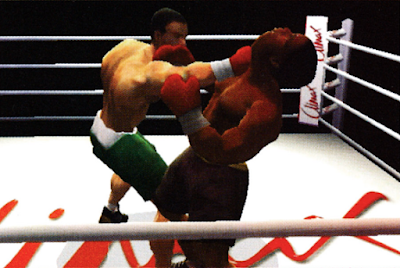
Source: DC-UK / Out of Print Archive

While Climax were quick to point out that Title Defense was at the opposite end of the spectrum to Ready 2 Rumble when it came to gameplay and feel, the one similarity both games would share would be the lack of any official boxing license, with EA Sports having the exclusive rights to real world fighters tied up in its pre-Fight Night era Knockout Kings franchise. 

"EA has most of the boxing licenses sewn up, I think. As we've seen with Ready 2 Rumble and other games, a license isn't necessary for boxing as it is for like football, yeah? If you look down the line and looking at a boxing game, we've got this idea of this game with a player to interact with, and an awful lot of the people you meet are going to be other players," Chris went on to explain during his interview with IGN. "In a game world like we envisage people will generate their own reputations and careers. Licenses are essentially about having pre-generated reputations that you're up against, yeah? But if you start thinking about a boxing universe then reputations get generated by players, which I think is far more interesting."

The World's SMALLEST Dreamcast Games!

A minature scale model of the Dreamcast by Retroldtech

The Dreamcast's GD-ROM format was a strange beast, being ever so slightly bigger than a CD-ROM but nowhere close to the capacity of the impending, mighty DVD-ROM. Packing in 1GB per disc, a majority of the Dreamcast's retail game library barely even tapped into this extra available space. As we will explore here, storage space isn't everything though: you can squeeze some pretty darn good games into not even a tenth of a GD-ROM's space!

Screenshot of the GD MENU Card Manager application
In this day and age of being able to store Dreamcast games on many different kinds of hardware, like SD cards or hard drives, it is possible to strip these games of any blank data that is used to fill up the rest of a GD, leaving just the necessary files to save space. This can be a risky move, as doing so can break games if they're not optimized correctly, but there are "means" to find games that have already been shrunk down to be used on a optical drive emulator such as GDEMU or MODE.
Photo of a 256gb SD card
My entire shelf of Dreamcast games and more fit on this! What a time we live in!
It's via this technique that I have been able to put together this list of games that are all less than 100MB! Take note, I am not including indie releases, prototypes, unreleased games, Atomiswave ports or software like web browsers and Fish Life. Also I haven't downloaded every game ever released so there are probably some visual novels out there that are tiny in size for all I know.

15. Silent Scope - 96.91MB

Photo of the Silent Scope game case
Konami's Dreamcast output was kind of disappointing. When they weren't busy cancelling Castlevania games for the system, they did throw out the odd bone with some arcade ports such as this here sniping-romp. It's a real shame the Dreamcast wasn't blessed with a sniper light gun like the Xbox, as the game played with a standard controller feels like it's missing something. Much like Samba De Amigo, though, it is playable enough this way but you can't help feeling like it's a lesser experience. Oh well.

14. Ooga Booga - 91.49MB

Photo of the Ooga Booga game case
This very unique collection of mini-games, with an emphasis on online multiplayer, released exclusively in North America and was touted as one of the big hitters during the push to sell people on SegaNet. Luckily, this is one of those games where online play has been revived, though even if that wasn't the case, this would still be worth checking out as there is nothing else quite like it on the Dreamcast.

13. Evangelion Typing Project E - 71.59MB

Photo of the Evangelion Typing Project E game case
I won't go into too much detail about this one as it has been discussed here at length in the past after Derek Pascarella treated us all to an English translation! Evangelion Typing Project E gives us another game to practice our touch-typing skills on, but instead of gunning down zombies with words you er...do Evangelion stuff! Like the anime! I dunno, I haven't really had a chance to play much of it yet, but definitely give it a shot if you're a fan of the show! There are in fact two translated Evangelion typing games, but I couldn't properly shrink the other one without it breaking, so I assume if optimized well it'd probably be a similar size to this one.

12. SEGA Tetris - 62.56MB

Photo of the Sega Tetris game case
This was the first Japanese import Dreamcast game I ever purchased from eBay, if I recall correctly! Why this one stayed in Japan is beyond me, but the console rights for Tetris have always been a bit of a confusing ride as Sega themselves found out when their Mega Drive/Genesis release had to be recalled... But this is Sega Tetris, not to be confused with Tetris...by Sega. Got it?

I really dig the presentation in this game. It's also kind of notable for being one of the last arcade Tetris games before the new rules came into play like swapping, hard drops and now legendary T-spins. The gameplay of this one gets ridiculously fast-paced, making it one of the harder Tetris games out there, though there are plenty of modes to mess around in, including a UFO catcher claw game with cute Sonic 1 remixes!

This is another one on the "someone get it translated and back online if at all possible" wish list!

11. Plus Plumb - 62.53MB

Photo of the Plus Plum game case
No, I wasn't going to pop down the shops just to buy a plum to photo this with. That'd be silly.
Only 3kB less than Sega Tetris, we have another Japan-only puzzle game! Plus Plumb is a pretty obscure one as far as I know. I discovered it back in around 2000 when a car boot sale I went to every week had a store of bootleg games (oh no! ☠️). These bootlegs were incredibly low effort, literally just plain CD-Rs with the game's titles penned on them, most of which were random Japanese games I'd never heard of until I took them home and fed them to the rotating Utopia reindeer.

Plus Plumb is a pretty standard match 3 versus game with some Pokémon-looking mofos chatting in between stages (with full voice acting!). I played quite a bit of this back in the day (did eventually buy a legit copy, don't worry) so the music from this is one of those earworms that has stuck with me for 20+ years!

10. Planet Ring - 62.44MB

The cover artwork for Planet Ring
Also within the 63MB range is this PAL exclusive, online-only mini-game collection that was given away on the front of magazines and the like. I never got around to trying this one out when the original servers were up, but luckily it's one of those games that is back online today! It even has voice chat so you can talk to someone other than your mutant human-faced fish for a change!