Showing posts with label Arcade. Show all posts

The NAOMI Games That Deserved Dreamcast Ports

Ask your average gamer with a passing interest in the Dreamcast to name their favourite titles for the system, and there is a good chance that you might hear answers like Shenmue, Skies of Arcadia, or Resident Evil CODE:Veronica. The console certainly had a healthy crop of long-form, narrative-driven sagas like this which remain an enduring part of its identity to this day. However, it’s probably just as likely that the answers you’ll receive are replete with brash, high-tempo classics such as Crazy Taxi, Power Stone, or The House of the Dead 2. Titles in this vein, which were so obviously shaped by their arcade roots, also played a huge role in making the Dreamcast what it was – and some of them shifted big numbers too (OK, big numbers for the Dreamcast).

In retrospect, given what was just around the corner for video gaming, it is not uncommon to hear the opinion that Sega’s swansong console was overly reliant on arcade ports. If it were to serve evolving tastes, so the argument goes, perhaps it needed to have attracted more games that were divorced from the arcade scene. Considering the multitude of factors that coalesced to make the Dreamcast a commercial flop, it is impossible to say with any certainty whether this theory holds much weight. Personally, I suspect it may have the tiniest grain of truth to it. If so, then daydreaming about how the console’s release library could have been packed out with even more arcade titles is perhaps a little bit perverse, but this is the Dreamcast Junkyard after all, and pontificating on this type of nonsense is our jam.

The NAOMI-Dreamcast Connection

For the uninitiated, I should probably explain that, in the same year that Sega launched the Dreamcast to the home market (1998), they also launched the New Arcade Operation Machine Idea (NAOMI) system for the arcade market. And, barring a handful of differences which made the arcade system marginally superior, the two were practically twins. 

The front page of a NAOMI press release from 1998, with the Dreamcast swirl incorporated into the logo (later to be dropped in favour of clarity). Image courtesy of Sega Retro.

I am not at all technically minded, and plenty of other articles by highly knowledgeable authors have been written about the affinities between the two systems, so I won’t feign expertise and start talking about chips and memory. For now, it is sufficient to say that because of the similarities between the NAOMI and the Dreamcast, porting games from the former to the latter was a fairly simple affair. Naturally then, masses of NAOMI titles were brought over to the home market using this route - or were they?

Relying on the data assembled by the wonderful archivists of Sega Retro, by my count 159 titles were released for the NAOMI, either on ROM cartridge or GD-ROM, but only 60 of these made it over to our beloved Dreamcast. Sure, among those 60 there are many, many, stone cold classics, ranging from blockbuster hits like Crazy Taxi through to lower-profile titles that have garnered a cult following over the years, such as Ikaruga. As thankful as I am for ports like these, those numbers mean that 99 NAOMI games didn’t make the jump over to the Dreamcast, and indeed, many never left the arcade full-stop.

In certain instances, this is understandable. The Dreamcast had its fair share of bizarre accessories, but would anyone out there really have wanted to cram a StarHorse terminal into their living room? Probably not.

OK lads, back to mine for a few hours of StarHorse?

For other reasons, games like Dragon Treasure, where players sought out ‘medals’ in a thinly veiled gambling loop, were probably not well suited to the home market either. You can’t lose money to yourself after all. Yet there are plenty of other games that could have feasibly made it onto the Dreamcast, brightening up its library, bringing us hours of joy, and getting savaged by a grumpy and short-tempered reviewer in the Official Dreamcast Magazine. So, in no particular order, here are the NAOMI games that I feel should have been blessed with releases on the Dreamcast.

Monkey Ball

Landing in arcades with aplomb in July 2001, Monkey Ball had that upbeat, blue-skies aesthetic that Sega development teams of the era seem to have mastered. On the face of it, rolling a twee monkey character around maze-like platforms to collect bananas and reach an end goal is very simplistic, but the combination of platforming and puzzle elements proved to be a big hit, and the opportunity to master the controls and beat prior scores lent the game a degree of depth and replayability. 

Monkey Ball screenshot courtesy of the Video Games Museum.

Before the end of the year, the game was ported to the Gamecube as Super Monkey Ball - the first game Sega published on a Nintendo home console following their exit from the hardware market. To the delight of an ailing Sega, it was a commercial hit, spawning a quick sequel and a franchise that has remained active to this day. But really, this game’s first home console destination should have been the Dreamcast, and had it hit the arcades a year earlier, I don't doubt that I could have been clasping a well-used copy of Monkey Ball in a battered PAL case right now. Fortunately though, thanks to the dedication of Memorix101, an unofficial port is in the works, and we may well see a fully working version in the near future.
Crackin' DJ

Rhythm games were a big deal in the late nineties with the likes of Dance Dance Revolution and Beatmania first taking the arcades by storm and then quickly transitioning over to the lucrative home gaming market. Of course, the Dreamcast was not immune to this bug and had a small but high quality library of rhythm titles, including the internationally recognised Space Channel 5, as well as Japan-exclusive hits like the Pop’n Music series. Yet, to my mind, it was a crying shame that Hitmaker’s Crackin' DJ didn’t make an appearance on Sega’s home console. Created specifically with a view to capitalising on the rhythm craze, its drawn out development process was by all accounts a tough one, and upon release it flopped, with blame partly falling on the daunting dual turntable controller that beginners struggled to comprehend.

Look mum, I'm a crackin' DJ! Flyer scan courtesy of LaunchBox Games Database

In light of its woes in arcades, not porting Crackin' DJ to the Dreamcast was in all likelihood the right commercial decision, but it means I was denied the opportunity to play it back-to-back with Jet Set Radio, in a fit of hip-hop fueled euphoria, from my dingy house in a bland English town. It’s also a missed opportunity for the Dreamcast to have been saddled with yet another endearingly cumbersome accessory that is only suited to a single game (or two if Crackin' DJ Part 2 was also ported in this hypothetical scenario). For now, we’ll just have to make do with listening to the soundtracks and dreaming of what could have been.

Illmatic Envelope

It’s well established that the Dreamcast has an exquisite library of shoot-em-ups. Furthermore, thanks to the circumstances that made the NAOMI an enduringly attractive home for shmup developers, it's also fairly well known that shmup ports from the NAOMI gave the Dreamcast a much longer official lifespan in Japan than elsewhere. Between 2002 and 2007, ten such games were released as Japanese exclusives for the Dreamcast, and in fact, the last ever Dreamcast GD-ROMs to be pressed and sold were reprints of Border Down in January 2008. Nevertheless, there were a handful of shmup titles released on the NAOMI that never saw the light of day on the Dreamcast, and one which would have been a perfect match for the little white box was Illmatic Envelope.

Released to arcades in June of 2008, Illmatic Envelope (AKA Illvelo) uses the same basic architecture created by Milestone for predecessors Radirgy and Karous, but applies an even more bizarre premise and what can only be described as a near-psychadelic visual presentation to produce a chaotic experience that is hard to put into words. We had glimpses of Milestone’s iconoclastic approach before, but in Illmatic Envelope it was allowed to run rampant.

A still screenshot really doesn't do this title justice... I'd recommend a video instead, such as this playthrough hosted by Insert Coin.

In late 2008, the chances are that an officially licensed Dreamcast port would have been just as viable as Milestone’s prior titles, with a small but dedicated fanbase still ready to snap up a print run of a few thousand copies. However, by the time Illmatic Envelope hit arcades, GD-ROM production had halted, which made such a prospect an impossibility regardless of demand. Fortunately, the game was not destined to be confined to the arcade with a Wii port appearing in late 2008, but that didn't fully satisfy my appetite. To this day I still yearn for a proper late-stage-Dreamcast DVD-case style release.

Mazan: Flash of the Blade

Released by Namco to arcades in 2002, Mazan: Flash of the Blade is a first-person hack and slash-type game, where the player takes on the role of an ancient Samurai tasked with defeating hordes of historically accurate monsters, including some rather terrifying penguins. The key feature the game is built around is that of a sword controller surrounded by a ring of sensors, the movements of which are then relayed into the game. Given that the action progresses on-rails, and considering the manner in which enemies present themselves, perhaps the most apt way to describe Mazan is as a “pseudo light gun game”.

Flyer scan courtesy of Neon Rocketship.

In the post Wii-era, the kind of motion controls the game offers probably aren’t as much of a draw as they once were. Indeed, after experiencing the horrendously clunky sword-fighting of Red Steel, some may have been put off the concept for good. However, the online consensus seems to be that Namco implemented the technology for Mazan well, and the game has drawn high praise from some well-informed commentators, such as Video Game Esoterica who describes Mazan as their “favourite unported arcade game ever”.

I’ll accept that releasing a Dreamcast port with a plastic sword and enormous sensor-ring accessory kit in 2002 would have been a reckless move. But surely something could have been worked out between the Samba de Amigo maracas and the fishing controller? Too ridiculous? Well then, I’d have settled for playing it with my Dreamcast mouse, or even the keyboard, à la The Typing of the Dead.

Kasei Channel Mars TV

The final game I'll cover here is the wonderfully vibrant Kasei Channel Mars TV, in which groups of up to three players compete in a succession of "quiz shows" that are broadcast from the planet Mars. Developed by Sega Software R&D Dept. 3 and released to arcades in 1999, Kasei Channel Mars TV is typically categorised as a "table game", but it is perhaps clearer to state that it ultimately consists of a set of mini games.

Screenshot courtesy of LaunchBox Games Database. However, again, seeing a video is a must, and I would highly recommend this footage from Insert Coin.

Obviously, the 2D art style and straightforward gameplay mechanics wouldn't have exactly been ideal for showing off the power of Sega's new home console back in 1999. However, in my eyes, Kasei Channel Mars TV could have been a perfect early online multiplayer game, perhaps releasing at a budget price in the vein of Toy Racer, or even being bundled as a magazine disc, as was done with Planet Ring in Europe. A trick was missed here, and the fact that the game has never made it out of the arcade is unfortunate.

Honourable Mentions

Some of you may be aware of the heartwarming story from 2004 where Dreamcast fans effectively saved the developer Triangle Service (a one-man band consisting of Toshiaki Fujino) from bankruptcy. Trizeal had tanked at the arcade, and upon gaining a licence to publish a Dreamcast port, Triangle Service issued an open letter calling for Dreamcast owners across the world to pre-order the game, which they duly acted upon. Perhaps less well known is that Triangle Service had intended to release their next NAOMI title, Shooting Love. 2007, on the Dreamcast in November 2008 to celebrate the 10th anniversary of the console and pay thanks to those who had supported Trizeal. This would have been a fitting end to the console's official lifespan, but alas, it was not to be, because GD-ROM production had stopped.

The NAOMI cartridge for Shooting Love. 2007 courtesy of Sega Retro

While not releasing a game because there is no physical capacity to produce discs is reasonable, what is less forgivable is that in PAL regions the Dreamcast only had two light gun games (Confidential Mission and The House of the Dead 2), and even in Japan, the Dreamcast only managed to muster two more (Death Crimson 2/OX and the Virtua Cop 2 re-release). A bit stingy, considering that there were several perfectly serviceable NAOMI light gun games that could have made the jump with little effort. OK, maybe not Gun Survivor 2: Biohazard CODE:Veronica, which was a hot mess with a terrible title to boot (six words and two colons, really?!), but the ancient Egyptian-themed The Maze of the Kings would have been lovely.

The Maze of the Kings title screen, courtesy of Sega Retro.

I'm quite ignorant about fighting games, and so I didn't think it was appropriate to pick one out in the section above, but I will note here that there were at least five fighting games released on the NAOMI which were never ported to the Dreamcast (Akatsuki Blitzkampf Ausf.AchseToy Fighter, Jingi Storm, several variants of Melty Blood and several variants on Guilty Gear XX). Given how well regarded Guilty Gear X on the Dreamcast is, I can only assume that fighting game afficionados would have been thrilled to see one of the four Guilty Gear XX variants that were released between 2002 and 2006 ported over too. As to why shmup developers of the time universally agreed that Dreamcast ports were still worthwhile, yet fighting game developers did not, I don't know. Maybe that's an investigation worthy of another article...

* * *

So there we have it. Based on a perfectly fair, rigorous and transparent methodology, I've decreed which games should have been ported from the NAOMI to the Dreamcast. However, I am humble enough to concede the possibility that I may have made a minor mistake - if there are other titles that you believe warranted a port, then do let us know in the comments below. Oh, and keep your eyes peeled for news on such ports becoming a reality in the near future. As we reported earlier, a port of Monkey Ball is underway, and a port of Cleopatra Fortune Plus (albeit "vibe-coded") has recently released, which hopefully means that the flood gates are now open.

P.S. To read a similar case made for titles from Sega's other arcade hardware (Model 3, Hikaru, Naomi 2) check out this article by Gregory Oborne over at It's Still Thinking.

Faster Than Speed: A closer look at the Atomiswave Need for Speed: Underground clone

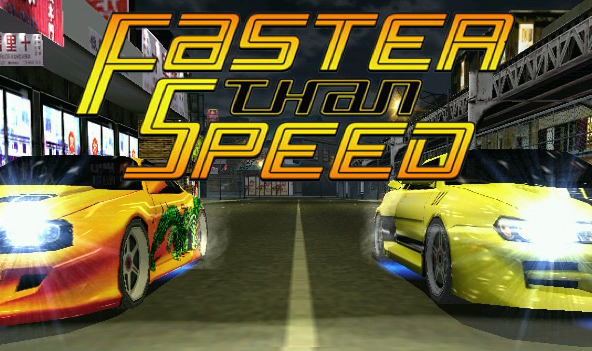
Alongside the recently covered Maximum Speed, Sammy's 2004 street racing title Faster Than Speed represents one of only two racing titles released for the Atomiswave arcade platform. Faster Than Speed differs from its stablemate in that it is a street racing title with an emphasis on high stakes, blink-and-you'll-miss-it, one-on-one vehicular duels through neon soaked city streets; in stark contrast to Maximum Speed's more traditional, reality-based stock car racing shenanigans.

Now, while it's quite clear that Sammy plundered Sega's own back catalogue when searching for inspiration for Maximum Speed (it doesn't require a PhD in the field of 'looking at stuff' to see the similarities between Maximum Speed and Daytona USA), the inspiration for Faster Than Speed is - checks notes - unequivocally Electronic Arts' phenomenally successful 2003 underground street racing title Need for Speed: Underground. A game that was released a year earlier than Faster Than Speed and which also offers high stakes, winner-takes-all races in highly tuned import vehicles, through perpetually dark (but beautifully lit) city streets, parks, boardwalks and other civic areas not really designed to be driven through at 100mph.

It's true that other night-themed racers existed in this period (Midnight Club springs to mind), and there were some small, independent art house movies that also touched on the topic at the time, but for me there is no other title that is as heavily borrowed from than Need for Speed: Underground when it comes to the aesthetic or the general demeanour that Faster Than Speed is trying to exude. Hell, even the name is a sort of side-eyed reference to EA's title - they may have the need for speed, but we're faster than speed! 

It's a subtle touch (almost as subtle as Bizarre Creations naming its flagship Xbox racing series after Gotham City in reference to Metropolis being cited in the title of its Dreamcast prequel); yet it is enough to corroborate my suspicions that yes, Faster Than Speed was plopped out by Sammy to cash in on the massive popularity of Need for Speed: Underground. And those small movies about cars that nobody saw. Cough.

Naming and visual conventions aside though, there's precious little else within the Faster Than Speed package that compares favourably to Need for Speed: Underground. That's because, well, Faster Than Speed is (whisper it) a bit naff. Before anyone leaps down my throat I want to qualify that the work done by such amazingly talented people as megavolt85 et al over at Dreamcast-Talk is the reason that Atomiswave games are now able to be played on the Dreamcast console. 

The Atomiswave is about as esoteric and rare as forgotten arcade platforms get, and due to that fact, the vast (vast) majority of people will have either never heard of the system; and even fewer outside of either the arcade collecting scene or - more recently - the Dreamcast scene will have ever had the opportunity to play many of the exclusive titles. Faster Than Speed is one such Atomiswave exclusive and that we now have the ability to sample these uncommon titles is a testament to the devotion of the Dreamcast community in bringing such long-lost games back to the fore. Even in light of the impressive resurrection of the Atomiswave library though, we mustn't turn a blind eye to mediocrity...which unfortunately is exactly where Faster Than Speed conks out.

As stated, Faster Than Speed was released in arcades in 2004. There appear to be two variants of the cabinet made available - both of which seem to be quite rare, according to the user ratings over at the International Arcade Museum. The first is an upright arcade cabinet with a steering wheel, pedals and the kind of bench seat that looks like it would cause irreparable damage to your arse after too long sitting on it; while the other is a sit-down model with a proper racing bucket seat (see the flyer below for details). 

An intriguing sidenote about this system though, is that the documentation (available on an archived snapshot of the Sega Amusements website) makes reference to several update kits, whereby arcade operators could install Faster Than Speed Atomiswave hardware, buttons and marquees in cabinets that previously housed such iconic racers as Rush: The Rock, Cruisn' USA, and even Ridge Racer (the upright cab, not Ridge Racer Full Scale).

The rear of the Faster Than Speed flyer (Image credit: Sega Amusements)

Taking even a cursory glance at the promotional materials for Faster Than Speed, it's quite evident that Sammy was positioning the game as a multiplayer-first experience; the operation manual explains how to go about activating the hidden 'Head 2 Head' mode, whereby two cabinets must be linked together via the optional router and then the Head 2 Head mode be switched on in the Atomiswave system menu. By default, this option is set to off. So what option is there for the arcade proprietor who only owns a singular cabinet? Four player alternate mode, of course!

Maximum Speed: A closer look at the Atomiswave Daytona USA clone

Maximum Speed is a white hot racing game that will thrill all your senses. Not my words - the words of whichever advertising guru came up with the guff adorning Maximum Speed's European marketing materials. And who am I to argue? Absolutley nobody, that's who. Right, let's get crack-alacking.

Maximum Speed was released in arcades in 2003 on the Atomiswave platform, and represents arcade racing in its purest form: there's you, a load of thick-as-mince AI adversaries, a plethora of tracks of questionable design quality and an ever-ticking clock. Thanks to the incredible development efforts of Megavolt85 et al over at Dreamcast-Talk in the recent past, Sammy Atomiswave titles are now playable on the Dreamcast, and we thought it was high time we took a more in-depth look at some of the games that have made the leap from the coin-op to the home and expanded the Dreamcast collection even further. 

If you aren't familiar with the Atomiswave story, it's worth taking a look at our guide to the short-lived Sammy arcade format here, and the story of how these lesser-spotted arcade titles ended up being ported to the Dreamcast here.

The two marquee racers for the Atomiswave platform were Faster than Speed, a sort of Need for Speed: Underground style street racing title stacked to the gills with neon strip lights, garishly painted hot hatches and more night racing than you could shake a Tokyo Extreme Racer at (check it out here); and Maximum Speed, a more traditional stock car style racer very much in the vein of Daytona USA. Its the latter of these two (obvs) that we'll be poring over here, to discover why, even though its not really up to the standard set by SEGA's own stock car racing series, Maximum Speed is probably still worth a look if arcade racing is your bag.

From the outset, it is clear that Maximum Speed is a game that's meant to be played in short bursts. Because this is essentially the very same code that would be played on a coin operated cabinet with a steering wheel and pedals (of which there were stand up and sit down variants), probably secreted away in the darkest reccesses of some brick and mortar arcade somewhere, there is no championship mode, no career mode or owt even hinting at anything more than "please put your money in dickhead, play for 5 minutes and then kindly piss off." The only real quality of life improvements for the home console are that the controls have been helpfully mapped to the standard Dreamcast controller, complete with analogue stick and trigger support (which is important - more on this later).

So what you're essentially getting, should you plop Maximum Speed onto your GDEMU (other optical drive emulators are available) is the authentic arcade experience with no home conversion improvements whatsover. Mainly because, y'know, Maximum Speed was never (officially) ported to anything. What you're confronted with when starting Maximum Speed is the ability to play a single race, in any of the initial three classes of vehicle, on any of the six circuits. There are 23 other vehicles also vying for the top spot during each race, and there's a clock counting down that replenishes by varying dwindling allotments each time you reach the next lap checkpoint. So far, so 'as you'd expect.'

The vehicle selection boils down to three different classes, with stock cars, trucks and open wheel variants being slectable, and then each type of vehicle being further sub-divided into three distinct flavours; one being an all rounder, one having better acceleration and the other having a higher top speed. Once you've selected your whip you get to select a track, of which there are six and these are, again, further divided into easy, medium or hard difficulties. 

The game explains these difficulty levels using a series of stars to denote how tricky they are, but the operations manual that I managed to scrape from the remnants of the now defunt SEGA Amusements USA Inc. website goes a little further, actually labelling the tracks as easy, medium or hard. Thanks Wayback Machine. For ease, I have now uploaded this operations manual here so you too can view it, dear reader. As an interesting side note, I did find that the preserved website for Maximum Speed appears to exhibit the text for SEGA Clay Challenge rather than the correct copy for Maximum Speed. Not sure why that is, maybe someone absent mindedly pasted the wrong paragraph in there when the page was created. A hangover maybe? Or just plain old incompetence? Who knows...but I digress.

Lost Atomiswave fighter KenJu ported to Dreamcast

The number of Atomiswave games ported to the Dreamcast continues to grow, and one of the latest offerings from developer megavolt85 over at Dreamcast-Talk is one we thought deserved a bit of attention. 

KenJu is a 3D fighting game from DreamFactory which was intended for release on Sammy's arcade system, but was apparently cancelled before it could be launched into brick and mortar arcades. The KenJu story has a happy ending though, as you can now get a glimpse at this fairly enigmatic polygonal scrapper either on actual Dreamcast hardware or via emulation! Here's a video of some (ham-fisted) gameplay by yours truly:

There's not a great deal known about KenJu, other than it was in development by DreamFactory (of Tobal No. 1 fame), who for unknown reasons decided not to release the game and consign it to the dustbin of history. Until now, that is. As far as I can ascertain, KenJu was due to hit arcades in 2005 before it mysteriously vanished without trace. KenJu did resurface in 2016 when a collector of Atomiswave boards released footage of it running, and then it slipped back into obscurity once more. The game has a fairly appealing visual style, with psuedo cel-shaded polygonal characters fighting in some nice looking 3D arenas.

The general consensus is that KenJu looks a little like Project Justice: Rival Schools 2, but for me that's pretty much where the similarities end. It has some interesting characters and plays pretty well, but it seems to be missing that certain something...which may hint at the reasons for why it was quietly canned. That said, it's quite good fun and the fact that the Dreamcast is able to recreate the game so flawlessly opens up the door for even more ambitious Atomiswave games such as Premier Eleven. Who thought we'd ever see the day the Dreamcast got a decent footy (soccer) game?!

It's worth noting that as with the other Atomiswave to Dreamcast ports released so far, KenJu is only available as a GDI file, so you'll need some additional hardware to play it on an actual Dreamcast. Personally, I had no joy getting the game to run under either DreamShell or RetroDream using both a Compact Flash modded system or an SD Card reader via the Dreamcast's serial port. It did however run using a GDEMU, so you may want to give that method a go if you're determined to play KenJu on original (well, original modded) hardware. That minor hiccup aside, KenJu seems to be perfectly playable and also mostly complete.

If you'd like to download the game for yourself, visit the Dreamcast-Talk forum thread here. Huge thanks once again to megavolt85 and other forum members who not only continue to expand the Dreamcast collection, but are also preserving some of the Atomiswave's most intriguing and lesser known titles.

Have you played KenJu on your Dreamcast or on an emulator? Let us know your thoughts in the comments!

Atomiswave games are being ported to Dreamcast...which is awesome

The Atomiswave, for those who may not be aware, was an arcade system co-developed by Sammy and Sega and released back in 2003. As explained in Ross's excellent deep dive on the hardware here, the origins of the arcade platform are thought to have been born out of Sega's pivot out of the home console market, leaving the firm with a surplus of hardware it had no use for (namely, bits of Dreamcast tech). 

The Atomiswave was first unveiled at the Japan Amusement Show in 2002, and piqued the interest of some of the biggest names in the arcade scene at the time, with SNK, Dimps, Psyko, Treasure, Compile, IGS, Visco and Tecmo all lending their support to the fledgling platform.

And lo, the Atomiswave became something of a hit among arcade gamers, hosting numerous inventive and colourful titles; and Sammy went on to purchase CSK's shares in Sega before eventually buying out the company in 2004. The intriguing thing about the Atomiswave is that even though its hardware was quite similar to the Dreamcast and NAOMI systems it was based on, Atomiswave games were incompatible with Dreamcast and so considered to be solely the preserve of dedicated arcade collectors. Until now, that is.

That's because developer megavolt85 has begun porting Atomiswave games to the Dreamcast, and if you head over to the Dreamcast-Talk forums you'll be able to see (and download) the fruits of their (very obvious) labour. So far, several Atomiswave titles have been ported to Dreamcast, and the GDI files made available. Of the handful of titles released so far, I have only played Faster than Speed - an arcade racer which plays (and looks) like the bastard lovechild of Need for Speed Underground and Scud Race.


It's actually a pretty fun racer, with lots of tracks and vehicles and some really nice handling. Oh, and it looks gorgeous. I've been playing this on ReDream on a MacBook Pro, and compatibility with some controllers has been a bit iffy, but as far as I can tell from browsing the forums, other emulators on PC work even better so your experiences may be better than mine. I did try to also play the game using an actual Dreamcast by loading the GDI file onto the Compact Flash modded Dreamcast, and while it would display the Faster than Speed custom artwork in Dreamshell, the game would not boot. So close...yet so far!

Edit - I got games working on a Dreamcast (thanks to Pcwzrd13 once again!). Check out the results.


One thing is clear though - this game and the work of megavolt85 is a revelation for the Dreamcast library. That Atomiswave games can now be sampled - in my case for the first time ever - is truly amazing; and a massive boon for digital preservationists. And this could be just the start of a whole new side of the Sega arcade library being opened up to Dreamcast owners who never knew such experiences existed. Exciting stuff indeed.


Apart from Faster than Speed, other Atomiswave games to be ported to Dreamcast in 2020 include King of Fighters XI, Metal Slug 6, and Samurai Spirits Tenkaichi Kenkakuden, and we'd be a bit daft to think that even more Atomiswave games are not on the cusp of being ported to our beloved console.

Head over to the Dreamcast-Talk forums to find out more. Thanks also to @pcwzrd13 for alerting those of us (me) who have maybe been a bit lax on keeping up with Dreamcast news this year.

A Quick Look At 18 Wheeler: American Pro Trucker

Of all the NAOMI to Dreamcast ports that were given a wide release - there are several that only got a limited release in Japan - 18 Wheeler is undoubtedly the one that gets the shortest of shrifts. Cast your mind back to those pastel hued days of Sega's arcade dominance and subsequent ports to the home tellybox, and names like Crazy Taxi, Ferrari F355 Challenge, Virtua Tennis, Outtrigger and Cosmic Smash instantly spring to mind. 18 Wheeler? Not so much.
This is odd for a couple of reasons, but the main one - for me at least - is the awesome way in which the game was presented in coin-op fashion in some locations. To whit, the game was set up with a huge mock truck cab that did a good job of allowing the player to feel like they were really driving an articulated lorry - it certainly felt very grand to the teenage me playing 18 Wheeler in the Namco Station at Manchester's Trafford Centre, anyway.
Since those heady days of the early 2000s, I have gone on to acquire my HGV license in real life (don't ask, it's a long story) and I am legally allowed to drive trucks of varying sizes. I can say though - with some authority - that driving a truck in reality is nowhere near as fun as it is in 18 Wheeler: American Pro Trucker. The game was ported from the arcade to the Dreamcast and released in PAL territories in June 2001 - several months after the announcement that Sega was ceasing production of the console. As you can probably imagine, the reception was lukewarm - to say the least.
This late release probably has a lot to do with the decision to allow Acclaim to publish the game on the PlayStation 2 and Gamecube after Sega had consigned the Dreamcast to the great bargain bin in the sky; but for the purpose of keeping this consignment of Dreamcast-related cargo on track, let's hit the road and take a look at Crazy Taxi's poor relation. More specifically what it gets right, what it gets wrong and whether it's worth your time and money. This is 18 Wheeler: American Pro Trucker...

Atomiswave Dev Kit 'SystemX' Discovered, Contains Fragments Of Unreleased Game 'Chicago 1929'

Ah, the Atomiswave. A beloved arcade system developed by Sammy that has its roots firmly planted in the fertile foothills of the NAOMI system heartlands, the Atomiswave is viewed by many as something of an extension of the Dreamcast family - indeed, our own 'Expanding the Dreamcast Collection' series goes into great depth looking at the Atomiswave, its hardware, some of its finest games and the link to the Dreamcast family.
The Atomiswave arcade system
With this connection in mind, a recent discovery may excite those interested in both the Dreamcast and the Atomiswave - an innocuous white box that looks for all intents and purposes like a standard Dreamcast dev unit; but one with the label 'SystemX' stuck over the familiar Dreamcast logo.
The Atomiswave dev kit, SystemX
After further investigation of the SystemX, owner Brian Hargrove has deduced that this is pretty clearly a Dreamcast development unit converted into an Atomiswave development kit...and even more intriguing is that it appears to contain fragments of a game that never saw a final release - Chicago 1929. Here, Brian explains how he came to own the SystemX and what he's discovered about the technical side of things:

Expanding the Dreamcast Collection: Part 2 - The Hikaru Seven

In part 2 of my Expanding the Dreamcast Collection series, we’ll be covering one of the other systems in the Dreamcast family, the Sega Hikaru. Much of the information from part 1 (such as how to play Naomi games) applies here, so if you haven’t already, I suggest you go and read part 1 now.

Back now? OK, great  - let’s get started.
Part 2: The Hikaru Seven
The Sega Hikaru was released into the arcades in the year 1999 becoming the third system in the Dreamcast family (the first and second being the Naomi and Dreamcast respectively). Development of the Hikaru was born out of the necessity to convincingly recreate fire, water and the subsequent lighting and particle effects required for such a task in the game 'Shouboushi Brave Firefighters.' Rendering such effects in a semi realistic manner was cutting edge at the time and beyond the capabilities of the original Naomi hardware, so a beefed up version of the system was hastily developed at the request of the game's development team.

The specs of the Hikaru differ from the Naomi in that it utilises a custom Sega GPU and doubles-up on many components; 2 x Hitachi SH-4 CPUs and double the amount of RAM and VRAM. Furthermore, Hikari units are standalone systems not designed for games to be easily interchangeable like the carts seen on the Naomi. Each unit comes with a ROM board containing a specific game fixed in-place inside a heavy duty metal case, much like the House of the Dead 2 board and the predecessors to the Naomi, the Sega Model 2 and 3.
Left: Model 2. Right: Hikaru
The word 'Hikaru (光/ひかる)' means 'to shine' in Japanese, and comes from the system’s ability to generate lighting effects far superior to other gaming hardware at the time. Hikaru was in fact the first piece of arcade hardware cable of rendering scenes with phong shading and Brave Fire Fighters was the first EVER game to use the shading technique. On a side note, the first game for home consoles to use this kind of shading (albeit on far more limited scale) was Space Channel 5, giving a shimmer to Ulala's dress. So there you go, another example of the Dreamcast family leading the pack in terms of advancements in the games industry.

Guest Article: Expanding The Dreamcast Collection Part 1 - The Naomi Connection

Ross O'Reilly is no stranger to the world of NTSC-J Dreamcast collecting or arcade gaming. Not least because he lives in Japan and his apartment is stuffed full of arcade machines and Dreamcasts. Here in this first of a series of guest articles at The Dreamcast Junkyard, Ross explains why the Dreamcast collection you have may seem complete, but is in actual fact far from it. The Dreamcast's history is intertwined with that of the Naomi arcade machine, and here Ross explains how you can expand your library of Dreamcast-style games by getting involved in the Naomi scene. At this point, I'd also like to point out that all of the quality artwork is the work of the author. Cough.

Ross, over to you...
I’d assume that many of you reading this already own a substantial Dreamcast collection or have at least played a wide variety of games on the system. It’s been almost 18 years since the console was first launched in its home territory of Japan, and while it’s still getting support (unofficial at least) to this day, the number of new titles has of course dwindled since its heyday.

Most gamers, even fans of the Dreamcast, moved onto greener pastures long ago. But what’s the hardcore Dreamcast fan to do?

Support the indie scene: A worthy cause no doubt, but let’s be honest, the quality of these titles are rarely anything special and never up to the standard of the Dreamcast’s best Sega developed games.

Import: Finding games that were unreleased in your home territory can be great fun. Whichever region you’re from, I can guarantee that there are a tonne of great games that never came to your shores. Many of us have already done this for years though; the list of import games we’ve yet to play is diminishing fast. What next?

Complete sets: The hardest of hardcore collectors can go for a complete set, but if we’re honest, the Dreamcast wasn’t that good; there were still a tonne of crappy games that came out for it. Do you really want a shelf half full of absolute rubbish you’ll probably never play and certainly not enjoy? Oh, you do? Well, even if that’s the case, I presume you wouldn’t turn down the chance to find some new 'good' games to play.

But don’t worry, there is still hope! In this series of articles, I’ll detail how you can expand your collection and find more than enough fresh content to keep you happy and out of the whisky bottle for at least another year or so. All you have to do is ever so slightly redefine the meaning of 'Dreamcast game.'

A Quick Look At Virtua Cop 2

There are lots of Saturn franchises that could and probably should have been re-made for the Dreamcast. Imagine if stuff like NiGHTS, Sega Touring Car or Fighters Megamix had been given a bit of a revamp in the graphics department and then re-released as budget games for the Dreamcast - it would have been great and allowed for more gamers to experience these titles. Obviously, in the case of Touring Car it would have taken a bit more than increasing the resolution to sort out the eye-watering jerkiness of the engine, but you get the idea. Remakes of last-gen titles are all the rage today, and there's no real reason that the Dreamcast couldn't have played host to a plethora of upgraded Saturn ports. This did happen at least once though, as Virtua Cop 2 can attest.