Showing posts with label NFL 2K. Show all posts

Joy to the Swirl: A Festive Feast of Christmas(ish) Dreamcast Games

This post has been updated and expanded from a version that was originally published in 2024. Enjoy!


This time of year the barrage of shopping, crowds, attention-thieving ads, and obnoxious mall displays can take their toll. Their cacophony of superficial Christmas chaos drowns the soul. 

Approaching my wits' end, I try to slow down and reclaim the seasonal spirit in whatever small ways I can muster. First there's the traditional stuff: the Christmas markets; the Griswold family antics; the catching up with friends over pints...

Before long, it's time for the festive video games.

I'll start with playing the obvious ones: Restoring cheer to Twin Seeds City in Christmas NiGHTS. Scaling the giant snowman in Banjo Kazooie's Freezeezy Peak. Mario dropping the baby penguin off a cliff...

It'sa wholesome holiday tradition!

Inevitably, I'll boot up my Dreamcast and really kick the season into high gear. Sega's swansong console is blessed with a multitude of titles which radiate a festive aura in one sense or another. Some are decked with Christmas cheer, others are dusted with wintry snowscapes, and a few simply relish in escapist revelry. Whatever the case, I thought I'd take a stroll through the platform's jolly games in this blog post. Settle in, grab a hot beverage, and huddle up to the warmth of your Dreamcast fan…

***

Blue Stinger 

Ditching any semblance of survival horror, Blue Stinger stirs a cocktail of action/beat ‘em up, B-movie camp, and Yuletide vibrancy. And that understates how hard it goes on all counts.


Whether you crave gory fisticuffs or holiday cheer, Blue Stinger indulges in both and spares all nuance. Want to obliterate Dinosaur Island’s mutant folk? Its vending machines dispense a feast of gatling guns, rocket launchers, lightsabers, and stun rods (my personal favorite) for your destructive delight. Need a jolt of merriment? It’ll bury you in an avalanche of neon snowmen, chipper earworms, and bizarre Pen Pen cameos. There are no half measures in Blue Stinger and God bless it for that.

Hassy Holidays, everyone!

In all, Blue Stinger embodies holiday excess and it will charm the shit out of you if you open your heart to its violent revelry.

Anyway, I’ll move on as I've spilled plenty more ink championing Blue Stinger as a highlight of the Dreamcast’s festive offerings and its library in general. We also celebrated it on the Dreamcast Junkyard's DreamPod Episode 137 and The Sega Lounge Episode 282, two podcast episodes fully dedicated to Shinya Nishigaki and Climax Graphics’ immortal holiday classic.

Christmas moral: We can brute force our way to Christmas cheer with a little kung fu and napalm.

Beverage pairing: Hassy & vodka

Dessert pairing: Gingerbread dinosaurs

Song pairing: This song on loop for 10 hours


Cool Boarders Burrrn! (NTSC-J) / Snow Surfers (PAL) / Rippin’ Riders (NTSC-U)

UEP System's Dreamcast snowboarding game sports a different title in each region but I've always appreciated their common commitment to alliteration. The game itself, though? Eh — 

My expectations were likely overblown by the spoils of other turn-of-the-millennium snowboarding games. I've always balked at Snow Surfers' relative rigidity. It affords limited potential for exploration and improvisation which contrasts unflatteringly against the expressive freedom of SSX, Amped, and Steep Slope Sliders. 


I still revisit Cool Boarders Burrrn! each winter, hoping to somehow enjoy it more than I traditionally have. The checkpoint timers are unforgiving and tricks are restricted to a handful of dedicated launch points (a la other Cool Boarders games). Each run offers just a couple viable approaches, yet — only recently — I've felt compelled to keep retrying them to improve my best times and trick scores. There's a certain hook there.

Decades onward, and unmoored from the shadow of its contemporaries, I've found a merry little game in Snow Surfers. With some persistence, carving the slopes feels refreshingly kinetic and the chill beats, nifty set pieces, and wintery village locales are charming as hell. It only took a couple of decades but Cool Boarders Burrrn! is beginning to feel a lot like a toasty tradition in its own right.

Christmas moral: Something...patience...something, something. Also, alliteration is alright.

Beverage pairing: Jingle Juice with Mountain Dew

Dessert pairing: Christmas crumble

Song pairing: "Walking in a Winter Wonderland"


Shenmue

AM2’s classic Santa stalking simulator needs no introduction here. I’ll just say that few things feel as cozy as moseying around Dobuita's bustling streets at Christmastime with the snow crunching under Ryo's sneakers. Tailing Santa around town, It's always amusing to see him peddle local boozers to underage teenagers before imbibing at them himself. Ryo can't stay out too late, though. Ine-san will worry and he still has to wake up early for his forklift job on Christmas Day. 

On a related note, Mark's pre-shift forklift races are mandatory but don't pay jack squat. That's bullshit.


Christmas moral: Unionize.

Beverage pairing: Milk

Dessert pairing: Nothing. Ryo doesn’t eat food in Shenmue because he is a ryobot

Song pairing: Sometimes You Have to Work on Christmas (Sometimes)” by Harvey Danger


Inside the Machine: The Making of NBA 2K and NFL 2K for Sega Dreamcast

I sat down with two original NBA 2K and NFL 2K engineers to learn how they helped build the two iconic sports games and I ask: can 2K Sports make a return to NFL greatness?

Moore’s Law, as described by scientist Michio Kaku in his 2023 book Quantum Supremacy, speaks to the concept that “computer power doubles every eighteen months.” But perhaps with an exception — the Sega Dreamcast seemingly defied Moore’s Law when it debuted in 1999. Game titles NBA 2K and NFL 2K for the Sega Dreamcast by studio Visual Concepts looked and played like sports gaming in a new medium.

Based on Sega’s NAOMI architecture, the Dreamcast would offer a glimpse of what advanced computational processing and graphics processors are capable of today. The Dreamcast offered buttery smooth frame rates, and was one of the first machines to offer competitive online sports gaming. Even more, Sega Sports, with its slow-motion instant replay systems and its patented 2K-camera bokeh, created the illusion that the 2K Sports world was alive — and I wanted to learn more about how these games were made.

I spoke with two different tools engineers on the original NBA 2K and NFL 2K development teams to learn about the technical, translational nature to their work on what was the new Sega Dreamcast hardware. What follows is a rare, unexpected, and deeply technical look inside the original 2K Sports, exploring how Sega and Visual Concepts created the foundation of NBA 2K and NFL 2K.

Custom Tools Engineering and Maya


The first topic of conversation was custom tools engineering. What are custom tools in game development and why are they important? Visual Concept’s tools engineers built custom solutions to smooth out animations, lighting, and graphics when those assets were built in the Maya software suite and ultimately migrated to the final game engine environment. I discuss those topics first with 2K Engineer One.

DCJY: May I ask if you worked on gameplay or designed tools for the games?

2K Engineer (One): I was a tools engineer, mainly writing exporters and customizations for Maya. As far as I can recall, at the time VC did not have dedicated design staff. Design was done primarily by engineers and artists. Greg and Scott, the founders, also contributed to design.

Excellent. What kind of exporters and customizations for Maya? Anything gameplay oriented or for ratings, or for visuals? Player ratings are usually very mysterious for sports games players.

2K Engineer (One): Exporters were mainly about modeling and animation. Modeling includes level design, e.g. stadiums, lighting, and character design. Character animation started as mocap data, which always needs a lot of cleanup. For example, mocap will typically clamp rotations to +/-180 degrees; that can result in a discontinuity when the source data crosses the threshold. Things like the peak of a sinusoidal wave that crossed the limit will be snapped 360 degrees to the other side. Mathematically they are equivalent, but it’s confusing to see, and can introduce sampling errors along the discontinuities.

So I’d create Maya plugins that would automate curve clean-up, or to apply various lighting tricks, or other things to automate tedious work that artists and animators would encounter. Sometimes I might add custom user data to the elements in Maya; these would tend to be more design oriented. Ultimately it would all get exported in formats that could be consumed by the game engine.

Things like player stats were tabular, maybe done in Excel. I don’t remember specifically, but that would make sense.

Thanks for this breakdown. I think this explains a lot of things that come up in games, like clipping, and various quirky animations that need those custom solutions.

Editor’s Note:

The turn of the millennium gave way to the rise of 3D sports gaming and powerful hardware. With better hardware technology, new software was developed to take advantage of the new capabilities that the Dreamcast now offered. With new software came new programming languages, new disciplines, and the demand for cross-disciplinary skilled workers to make sense of it all.

Tools engineers and technical artists would prove to be a key for Sega Sports and Visual Concepts in maximizing the Dreamcast’s capabilities from launch.

Merry 'Castmas! - The Festive Games of the Sega Dreamcast (2024 Edition)

This time last year, I hardly had time to enjoy the holiday festivities. I couldn't even put up a tree or lights, let alone restore holiday cheer to Twin Seeds City. We were swamped with uprooting our lives, dog, and 15 years of belongings as we prepared to move across the Atlantic. It made for a hellishly stressful shitmas but it's all a blur now.

This year is the opposite, mercifully. So far I’ve enjoyed relaxing and rekindling the holiday spirit. I’ve indulged in some longstanding traditions, while adopting several new ones from this side of the pond. The Christmas markets, Sunday roasts, and excessive pints at my locals have helped make this season all the merrier. Of course, I’ve also been playing a bunch of Dreamcast games to help celebrate the season.

Sega’s final console imparted us with a multitude of titles that could be considered festive in one sense or another. Of course, these games will resonate with different folks in different ways. Some are dusted in snowscapes, some are lit with Christmas decor, and some just have festive vibes. Whichever the case, the following games have helped restore my holiday spirit in their own odd and unique ways…


Blue Stinger 

I’ve spilled plenty of ink championing Blue Stinger as a highlight of the Dreamcast’s festive offerings, and its library in general. We’ve also rambled about the game in several of our podcast episodes by this point. In fact, you can listen to our latest DreamPod dedicated solely to Shinya Nishigaki and Climax Graphics’ holiday classic.

Ditching any semblance of survival horror, Blue Stinger teeters a balance of action/beat ‘em up, B-movie camp, and festive vibrancy. Yet that understates how hard it goes on all counts.

Whether you crave gory fisticuffs or holiday cheer, Blue Stinger indulges in both and spares us from all nuance. If you want to obliterate Dinosaur Island’s mutant folk, its vending machines offer a buffet of shotguns, stun rods, rocket launchers, and lightsabers for your destructive delight. And if you want Christmas cheer, it will bury you in an avalanche of neon snowman, chipper earworms, and festive/bizarre Pen Pen cameos. 

Blue Stinger embodies holiday excess and it will charm the shit out of you if you let it.

Christmas moral: We can capture the magic of Christmas with just a little brute force...and tequila.

Beverage pairing: Mistletoe Margaritas

Dessert pairing: Hassy pudding

Song pairing: My friend Angela’s metal karaoke rendition of “Feliz Navidad” followed by this song on loop for 10 hours


Cool Boarders Burrrn! (NTSC-J) / Snow Surfers (PAL) / Rippin’ Riders (NTSC-U)

As a game without a consistent title between regions (for legal reasons), I at least appreciate their alliteration.

Frankly, I’ve always wished I enjoyed UEP System’s Dreamcast snowboarding game more than I traditionally have. I still return to it every couple years thinking that maybe it will finally click. It never fully does but we’ll muddle through somehow.

Perhaps my expectations were overblown by my love for other turn-of-the-millennium snowboarding games. I always balked at Snow Surfers’ stifling rigidity. It offers limited potential for exploration and improvisation, which contrasts unfavorably with the likes of SSX, Amped, and even Steep Slope Sliders. But in its own charming way, that also makes Rippin’ Surfers a unique kind of grind. Countdown timers are unforgiving and tricks are limited to specific launch points (as with other Cool Boarders games). There are just a few viable approaches to each course, which I was compelled to practice ad nauseam to improve my best scores and inch towards more optimal runs.

Unmoored from the expectations of its contemporaries, I found a merry little game in Burrrn Riders. With a little persistence, carving the slopes feels surprisingly serene, and is further bolstered by the chill beats and nifty set pieces. It’s not an expansive game but its simplicity makes it feel oddly cozy.

Christmas moral: Sometimes it’s nice to enjoy games for what they are.

Beverage pairing: Jingle Juice with Mountain Dew

Dessert pairing: Christmas crumble or something with alliteration

Song pairing: Merry Muthafuckin’ Christmas” by Eazy-E


Shenmue

AM2’s classic Santa stalking simulator needs no introduction here. I’ll just say that — with Shenmue’s dynamic weather system — I had to load through all my Xbox saves, all my PS5 saves, and a dozen VMUs before I finally found a save state where it was actually snowing in Dobuita. After that, I had a jolly time crunching through the snow and following Santa around town as he peddled local boozers to underage teenagers before imbibing at them himself. We couldn’t stay out too late, though. Ryo still had to show up for his forklift job on Christmas Day. 

On a side note, Mark's mandatory, pre-shift forklift races do not pay overtime and that’s fucking bullshit.


Christmas moral: Unionize.


Beverage pairing: Milk

Dessert pairing: Nothing. Ryo doesn’t eat food in Shenmue 1 because he is a ryobot

Song pairing: Sometimes You Have to Work on Christmas (Sometimes)” by Harvey Danger


An interview with David Perkinson - Producer of NFL 2K and World Series Baseball on the Sega Dreamcast

Before 2K Sports, It Was Simply: Sega Sports.

The inception of Sega Sports' World Series Baseball on the Sega Dreamcast is a story of in-house rivals sharing ideas across miles of oceans. This was possible partly because game design is its own science; its own language — not limited by geopolitical or even cultural constructs. Perhaps it is no wonder then that SEGA of America and Sega of Japan shared Sega Dreamcast technology that would become the foundation to iconic SEGA Sports game franchises.

Before the corruption of 2K Sports as we now know it, it was Sega Sports. I spoke with former Sega Sports producer David Perkinson (World Series Baseball, NFL 2K, Heavy Rain) to discuss how Sega Sports was shaped in its defining Dreamcast era.

Credit: Sega Retro

Steven Montani: How did you end up at Sega?

David Perkinson: Yeah, that’s a good question! I graduated from college in the Spring of ’93. I went to school in Ohio, and my sister and her husband lived in San Francisco. My sister had been doing some work at the time with kind of a small, wannabe-publisher, and they had a few games they were working on. At the time, CES was the big gameshow pre-E3. At the time, CES was in Chicago, and I was in Ohio and they wanted somebody to work the booth. I did some work for this company, and I was not being asked for too much. I helped people play, rebooted systems, and handed out pamphlets. CES ended and they asked me if I wanted to come work for them in the Bay Area for the summer. So I did. I flew out there and I began working for them without any real defined terms. Neither party knew if it would be a long-term thing, short-term thing or whatever. I worked there a couple of months at the time, sending reviewable builds out to media people and general stuff around the office. I just graduated from college and my friends had graduated from college and it was going to be our last summer together so I decided I was going to head back home. I left that gig. And then committed myself to moving back to the Bay Area. My sister was there. I had an easy in. I drove from Ohio, got to the Bay Area on the Saturday of Labor Day weekend.

I saw an ad in the paper that said: “growing software publisher needs testers.“ It did not say who it was. Since I just had done that, I decided to apply. Applied on Monday. Got the job on Tuesday. And then I was around Sega in different incarnations, always working on Sega stuff, for about ten years. I started out in [quality assurance], spent maybe about a year in QA, and then moved into production. I always had an affinity for the sports stuff, so I began working on the Genesis sports stuff. That transitioned into 32X and the Saturn, and then into Dreamcast, and ultimately into publishing Sega Sports or ESPN video games even, developed by Sega and Visual Concepts for other platforms.

My role kind of increased. I was assistant producer, associate producer, producer, and then doing all kinds of stuff. Like taking on projects from Sega of Japan, working with developers in the United States on stuff from scratch. Almost all of it in the sports realm.
NFL's Greatest: San Francisco vs. Dallas 1978-1993 - one of the earliest games David worked on as a tester.

Did you have a passion for sports beforehand, before entering the game industry? Or did it develop while you were there?

I played an embarrassing amount of Techmo Bowl in college. Blades of Steel, Double Dribble on Nintendo Entertainment System was kind of a fun one. It had that hook shot from the corner that was kind of a bug that the shot was never missed. I was always a huge sports fan growing up — it was a passion of mine and so I kind of fell into it naturally. When I got on sports games working in QA, I just had a good connection with them and built really good working connections with the production teams on the SEGA side, and developers on development side.

So that was an MBA of sorts in production, in game development, and in publishing during your time there…

Yeah! One of the great things about it was that the group of people working there — it was a really eclectic group of people, a lot of whom got their start at the same time as I did, who were still in there doing really cool stuff. They accomplished great things in games, or whether they moved into other areas of software development. We had writers, actors, musicians, just the gambit of creative people that worked there. We were kind of like-minded. I consider myself incredibly fortunate, right place at the right time.

That’s one part of it. The other part of it that made it so interesting and kind of challenging — every hardware generation, the rules completely changed. The expectations would change. The technology would change. The things you had to work on and think about and the tools used to develop the games and the complexity and the visual improvement — all of it was constantly evolving. You could always apply lessons before of making successful products, but there was a fair amount of improvisation in every hardware generation. You really had to think quickly and problem solve, and find a way to execute the best product given the constraints. Super-fun.

That is in line with some of the documentaries I’ve seen on SEGA. Where SEGA had been considered, maybe back in those days, like how we'd see modern indie studios — an eclectic personality to the entire studio. People were not afraid to take risks, explore avenues with their creativity and mess with different mediums mixing different disciplines.

Even outside of the sports stuff, you had all of types of creativity coming from SEGA of Japan. Just legendary designers making incredibly famous products. There was a fearlessness and spirit of innovation that led them to take risks. Even if the games did not blow out sales, those innovations would drive something else that would show up in some other product that could make that successful and shine. At SEGA of America, even outside of the sports world. I think of stuff like Ecco the Dolphin. Incredibly creative game.

You Had One Job! - European Dreamcast Game Box Screw-ups

Since the beginning of time - well, gaming - video games have come in boxes with artwork. The artwork was put there to sell the experience to you, to convince you why the game inside that box was the game you needed to leave the shop with that day more so than any of the others. By the time our beloved little white SEGA box came onto the market, it was the sixth generation of gaming. Even games released for the microcomputers of the '80s had box art, so, by the late '90s, it was very much an established norm.

On the Dreamcast, there was a clear template for each region of how the box artwork should look. In Europe, you had the nice blue base template and logos; a front cover, a spine, and the back cover. So simple and elegant, everything looking uniform on a shelf... what could possibly go wrong?

Well, quite a lot it turns out...


Tokyo Highway Challenge

Right from day one, Dreamcast game publishers found sticking to simple templates difficult. Tokyo Highway Challenge (known as Tokyo Xtreme Racer in the USA) is actually one of the Dreamcast’s more under-appreciated titles. Leaning heavily into an Initial D vibe, the game places you onto Tokyo’s C-1 “highway” and tasks you with challenging and beating all the other illegal street racers in a quest to become the ultimate import racer. Quite how you do that in what are domestic cars in Japan I never did figure out, but that’s not what we’re here to discuss! So, how exactly did Crave fail on the console's European launch day with their game packaging?

Clearly using the white arc of the US theme.

Mistake: Using the US Dreamcast template on the front cover. Although it does at least look like they tried, seeing as they went to the effort of removing the little orange triangle that represents the console's power LED...


NFL Blitz 2000

Also on day one, it wasn’t just Crave who were struggling with the idea of box art. Step forward, Midway! In their defence (“DEFENSE!!!”), they did have more boxes to get right at launch with Hydro Thunder, Ready 2 Rumble and Mortal Kombat Gold all releasing alongside NFL Blitz 2000.

NFL Blitz 2000 is an arcade sportsball game. I hear it's good fun, but I won’t lie, I’ve never understood a sport called football where most of the game has the players holding the ball and running. Anyway, having graced us with multiple launch titles, I can confirm that Midway got the front and back of the game perfect. So far, so good. So what on earth could possibly go wrong from here?

Just the Dreamcast logo and the code on the spine.

Putting the game on a shelf only emphasises the issue even more... 

Mistake: Forgot to put the game's name on the spine.

A Dreamcast Launch Retrospectacle: Celebrating/Ranking the Games of 9.9.99


Note: This post was originally published on September 9th, 2020 but most of it should still be relevant, even if some of my maths and Fall Guys references are not. I also enjoy the original Sonic Adventure way more now than I did back when I wrote this, and I was admittedly a bit harsh on the Midway games. Anyway, thanks for reading!

---------------------------------------------------

Well, shit. It’s been 21 years since the Dreamcast’s North American launch. That makes it old enough to drink here.

Legally.

Of course, that’s hardly news for all you folks outside of the States. In Japan, the Dreamcast has been of legal libation consumption age for nearly two years, both because it came out almost a year earlier and because the nation’s legal drinking age is 20. Doubly so for most European countries. In Germany, kids as young as 14 can drink wine and beer with their parents’ consent, which means the Dreamcast has been allowed to partake in the devil’s sauce for over seven years (with permission from the Saturn and Mega Drive, of course). And apparently you Brits have been legally allowed to drink at home since you were five (?!) years old. If true, the Dreamcast has been pounding pints in the UK since the Nintendo DS was in nappies.

Anyway, I write all of this because I find it both a convenient and unnecessarily convoluted excuse to crack open some brewskies and reminisce about the Dreamcast’s iconic launch library all those years ago. In the spirit of the occasion, I’d like to think of this feature as a Dreamcast 21 run of sorts.

I’ve always been fascinated with video game console launches and the “next gen” titles that usher us into each new era of gaming. I believe these launches provide unique insights into how platform holders aspire to position their consoles and contribute to the broader evolution of the medium. Console launches give us a glimpse into the creative mindsets of developers seeking to innovate with the new technological possibilities afforded to them. Then there’s the sheer spectacle of it all, which can also be fun in itself.

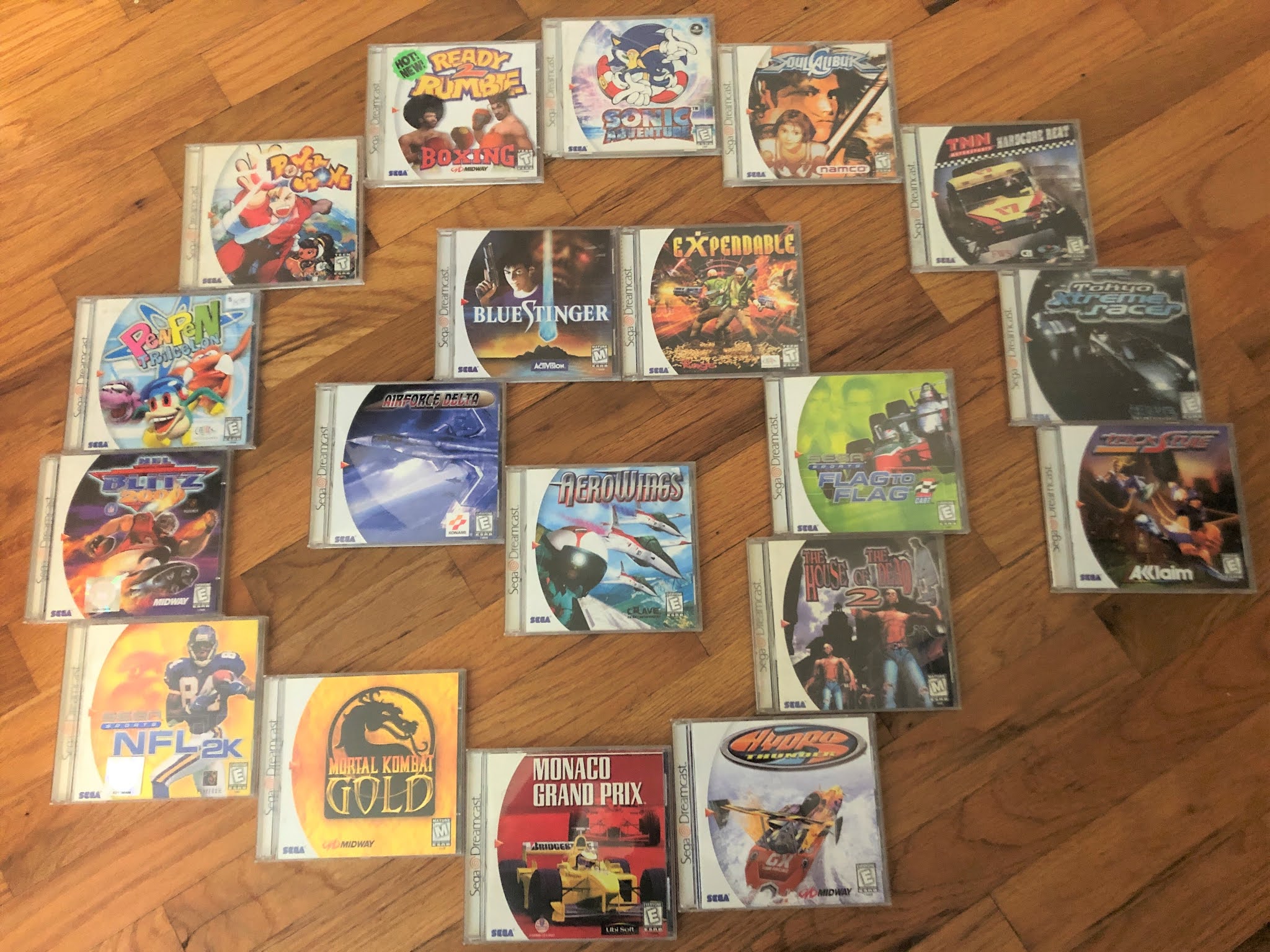
When it comes to the all-time great console launches, I can’t think of a better time than the sixth generation. Leading the way, of course, was the Sega Dreamcast. You probably don’t need me to sell you on the brilliance of its launch collection. At least in North America and PAL territories (sorry, Japan), there was almost a magic surrounding it. From day one, the Dreamcast hosted a legendary library of excellent games, many of which remain widely revered by the Junkyard community. I’ve recently replayed all 19 of the North American launch titles and I’m surprised which ones have held up at least as well as, if not better than I expected. Others, less so. More than anything, revisiting the Dreamcast’s launch library has helped strengthen my appreciation for the creative risks Sega took with its final console debut, as well as the more enduring impacts its games ultimately had on the medium.

It boggles my mind to consider the rare confluence of factors that could've enabled the Dreamcast to spoil early adopters with such a wealth of launch day riches. Back then, and for a variety of reasons, console launch lineups seemed more crucial for setting the tone and tenor of the experiences we might associate with those platforms. Perhaps the relative technical strides between generations underscored the need to show off a diverse stable of games that could never have existed previously. And before development costs skyrocketed in the HD era, maybe it was easier for more devs to begin and finish their projects in the time between receiving dev kits and preparing for launch. At the very least, developers might've been freer to work in peace without us asshat fans yammering at them on social media all the time.

So now, after 21 years, I figured I’d share my thoughts on all 19 North American Dreamcast launch titles through a not-completely-sober, retrospective lens. Here are my totally biased and nostalgia-be-damned takes on the Dreamcast’s original launch lineup. And in no particular ord—actually, screw it. I’m not usually a fan of ranked game lists but I’m a couple of beers in at this point and I’m fine with being a hypocrite.

OK. Worst to first. Let’s go...