Showing posts with label Derek Pascarella. Show all posts

Segagaga has Finally Been Translated into English — Here's How to Play It (and How it was Achieved!)

The headline you see above is not some form of freaky clickbait, nor is it a two-month-early April Fool’s prank. It is, however, signalling one of the biggest pieces of Sega Dreamcast news that we will probably ever report here on this website. Some thought it would never happen, but the day has finally arrived: Segagaga is now playable in English, thanks to the incredible work of a team of dedicated fans led by Exxistance. If you just want to know how to play the translation, skip to the end of this article, where you will find a link to a download and instructions on how to apply the patch to your existing disc image of Segagaga. But we felt it was important to document what made this holy-grail translation possible — and to ensure that those responsible receive the recognition they deserve. So read on if you want to learn more!

If you’ve spent more than ten minutes in Dreamcast fan circles, you’ll undoubtedly be aware of Segagaga, a 2001 Japan-exclusive RPG that tasks players with running Sega as it tries to regain market share against its main competitor, DOGMA (Sony, basically). Developed by Hitmaker and published by Sega, the game is well known for its wacky humour (much of it at Sega’s own expense) as well as its abundance of references to the company’s past IPs. Because of this, Segagaga has retained an almost mythical quality among Western Dreamcast fans, and from the moment it became clear the game wouldn’t be released outside of Japan, it has without a doubt been the most anticipated English translation of any game in the console’s library.

But as I'm sure you're aware, Segagaga's translation journey has been wrought with roadblocks. Many projects have started up over the years, only to inevitably fizzle out. But as we previously mentioned at the top of our interview with Segagaga’s creator, Tez Okano, the reason for the game’s multiple-decade stint in translation hell wasn’t due to a shortage of skilled translators capable of handling its distinctly Japanese humour, but rather a series of daunting technical hurdles.

The primary challenge stemmed from Segagaga's use of the Dreamcast’s BIOS font, as editing it was thought to be impossible for the longest time. What's more, the game only supported Shift-JIS encoding for text, a common two-byte format for Japanese language that was widely used in video games of the era (and still is today, though typically alongside ASCII or UTF support). Without changing the game to retrieve narrower Latin alphabet characters from the BIOS instead, the original Shift-JIS would leave the in-game text looking horrible, and too big to fit in numerous places.

Demonstration of Shift-JIS encoding, provided by Derek Pascarella.

By contrast, many other Japanese Dreamcast titles rely on their own internal font sheets, unique to each game, meaning that savvy hackers can go in and swap a Japanese font sheet for an English one, adjusting spacing between characters, along with other necessary tweaks. Because of this, these games were able to see successful translations much sooner, and form the majority of past fan translations we've seen for the console over the years. 

After two decades of unsuccessful attempts at translating Segagaga, it was time to bring in the big guns. Cracking a technical nut this tough required a meeting of some of the most talented minds the Dreamcast scene has to offer, including megavolt85, mr.nobody, VincentNL, Derek Pascarella, and madsheep. If it weren’t for them, I can only imagine how much longer it would have taken for us to see this translation become a reality… perhaps another decade?

In steps megavolt85, hacker extraordinaire, who was one of two previously responsible for making it possible for Atomiswave games to be ported to Dreamcast. On megavolt's input, Derek Pascarella explains:

"megavolt85 modified Segagaga to interpret ASCII, the single-byte encoding commonly used for the Latin alphabet. Not only that, but he modified the game to read from the ASCII section of the BIOS font, rather than the Shift-JIS section."

The next step was to make it so that ASCII from the BIOS could be edited. This was where Derek worked his magic, and shares how he made it happen:

"Segagaga speaks directly to the Dreamcast’s BIOS when it comes time to render text on screen. After megavolt85 did all of the assembly hacking to force the game to interpret ASCII-encoded text and then pull from the ASCII section of the BIOS font (rather than Shift-JIS), I started poking around a bit to see how it all worked. What I discovered is that the game actually copies the entirety of the BIOS font into RAM pretty near the location where the game executable ends! So, I disabled the assembly code that performed this copy, then also disabled the code that null’d out that portion of RAM before doing the copy. I then appended the BIOS font to the end of the game executable, and just like that, the font data was precisely where the game expected it to be, and it could be modified! This came in handy a number of times as font glyphs needed tweaking for optimal appearance."

See how much better ASCII looks in comparison:

Demonstration of ASCII encoding, provided by Derek Pascarella.

It appeared that the first-documented Segagaga translation patch project —which began in 2006— did manage to make progress in this regard, but unfortunately wouldn't see an update past 2013. While nothing technical from that previous project would make it into this one, project lead and texture artist Exxistance reveals that he was still able to utilise a wealth of other archived community resources.

"What was helpful [...] were the various artefacts people left on the internet, including the FAQs on GameFAQs that were created back in the mid-00s. Those were especially useful in helping me get my bearings as I initially worked through the game. Other helpful resources included The1Ross’ Open Source Translation Project, as well as various YouTube videos like Korone’s full playthrough of the game."

It was actually on a Dreamcast-Talk forum thread initially created to share The1Ross' project, where Exxistance would post his English-translated edits of Segagaga's textures. From there, mr.nobody —who previously worked on the English fan translation of Dreamcast horror title Seven Mansions— would get in contact with Exxistance.

"mr.nobody was the first person to reach out and help with textures, and he really became the glue that brought all the project players together. When I started, I was mostly just posting texture updates into the void on Dreamcast-Talk. But once mr.nobody reached out to help with textures, the project began to snowball. At first, we coordinated texture work through Google Sheets, but then he created a Discord server that brought the whole team together. One thing I want to highlight is that mr.nobody handled all of the enemy textures, and he brought a wonderful attention to detail to everything he did. For example, the enemy “Influenza” has a “face” drawn on it that is the Japanese onomatopoeia for "coughing," mr.nobody cleverly updated the face to read “flu” in English while still looking like a face. Just brilliant! Additionally, mr.nobody helped with the editing of the videos, like masking off Japanese text and such."

Left: original art for "Influenza".
Right: mr.nobody's excellent "flu" face edit.

VincentNL, known around these parts for his stellar work on the Rent-A-Hero No.1 English fan translation, would provide some vital input to make Exxistance and mr.nobody's texture work... work.

"VincentNL was vital in building the texture container extractors and repackers. Without his work on those tools, all of the texture work would have just been sitting there, waiting for someone to come along and make it usable. His texture tool, “SGGGE,” made replacing a texture with a simple edited .png an absolute breeze."

VincentNL was also the reason you'll be able to play Segagaga's infamous shoot 'em up section with English subtitles. Duralumin, who worked on patches for Nakoruru and Capcom Vs SNK 2, was the one who provided the English translation for this section. This was an important addition to the patch, since the section features an exchange between two major characters that delivers some key backstory. Derek offered some technical insight into VincentNL’s contribution to Segagaga’s shmup section:

“This hack is incredibly clever. Segagaga, like a wealth of other Dreamcast games, leaves behind debug code, including a debug font. This means there are assembly functions at the ready that hackers can call on to render text on screen however and whenever they'd like. VincentNL wrote a tool that allowed the team to enter subtitle text and its timing, and then automatically inject code to display said subtitle text at the right time, all the while leveraging that in-game debugger text rendering routine.”

madsheep, who developed one of the earliest tools to make building SD cards for GDEMU a doddle, was heavily involved in the technical side of the project. Exxistance had the following to say about madsheep’s involvement: 

"madsheep built multiple tools, including the primary main binary translation tool with a nice GUI. This made updating text in the main binary as simple as finding the text, changing it, and clicking “Save,” while the tool automatically relocated the text to the appropriate new area in the main binary and updated pointers as needed. It was actually madsheep’s “MES Tool” that pushed me to jump in and work on the text, since I had already done a fair amount of texture work and wanted to tackle something different. On top of that, madsheep helped solve many smaller issues on the project, including a problem we had with the spacing of magic spell costs."

Once some of the toughest technical hurdles were stomped out, Exxistance and his team could finally focus on translating the game into English. A big name he wanted to shout out here was Sixfortyfive, who handled text editing and shared a lot of in-depth knowledge about the game.

"Sixfortyfive reached out to me on Twitter and mentioned that he had been part of one of the earlier translation efforts, and he volunteered to help with testing. It quickly became obvious, though, that his knowledge of SGGG is vast — he likely understands how the SIM elements of the game work better than any other English-language resource I’ve encountered. Because of that, he also contributed heavily to the text editing, providing a lot of excellent recommendations that helped us further polish the translation."

That’s not to say there weren’t still challenges to overcome on both the translation and technical side. For Exxistance, a few came to mind:

"For me, there were a few challenging areas. First was the Negotiation Q&A portion, where you’re supposed to choose the answer that you think the enemy that you’re negotiating with would say, and many of the questions and answers are humorous and/or esoteric. So translating these in a way that didn’t butcher their original intent but also fit within the physical character limits we had was a tight rope to walk. Plus, there’s over 1,000 combinations of these, so from a sheer time perspective, I think it took me a month and a half to work through them. 

The Random Name Generator was tough to translate because the original combines traditional Japanese surnames with places or things. Translating them into English was easy enough, but then there wasn’t enough physical space for the final combinations (which can only have 17 characters). So these had to be truncated in a way that made sense but also kept a bit of the ridiculousness of the combinations. 

Another challenging aspect was often researching 20-30 year old gaming references and coordinating with the translation reviewers to ensure we got them right. Especially in the archives, there’s a lot of commentary from what I presume is Okano, with many references that predate my jump-in point in gaming. So ensuring that we thoroughly researched a particular reference and translated it correctly was big."

Something important that should be clarified before we move on is that machine translation (specifically a combination of DeepL and ChatGPT 4o/4.5) was used during the initial hacking phase for testing purposes. Once it was time to translate the game proper, multiple human translators then took over. They spent many months crafting the translation you see in the final release. This included researching and pinning down the game’s many references. For more of an in-depth explanation on this from Exxistance, click here.

If you’ve made it this far, the wait is almost over — you’re just about ready to download the English translation patch for Segagaga. The game has built up a legendary reputation among English-speaking fans over the years. Exxistance shares his idea of what you can expect:

"I suspect that many people may think SGGG is like your traditional 20-30 hour JRPG with light simulation elements. It’s really a mish-mash of things, more akin to a visual novel/RPG/simulator, and I actually think that’s what makes it hold up very well today. The game isn’t overly long and it’s meant to be played multiple times. The game also sprinkles mini-games throughout so that you’re never just doing the same thing the whole time. And it included forward-thinking elements like skipping random battles, a feature I don’t think we really saw in many games until the past decade. 

I think people can expect a very humorous, light-hearted RPG that shines as a love letter to SEGA, otaku culture, and the game development profession."

So, the time has finally come to play the English translation of Segagaga! Here's what you need to do:

  1. Go to the translation project’s GitHub page and download the patch.
  2. Follow the relevant patching instructions in the ReadMe to patch your existing Segagaga disc image (.GDI or .CDI).
  3. Once complete, you can load your patched .GDI onto a Dreamcast ODE (such as GDEMU, MODE, etc.) or play it on an emulator. If you patched a .CDI, you can burn it to a CD‑R and pop it into your Dreamcast. If you’re unsure how to burn Dreamcast games, there are plenty of step‑by‑step tutorials on YouTube that will walk you through the process.
We hope you enjoy finally getting to experience one of the Sega Dreamcast’s most legendary Japanese games in English! If this is your first time playing Segagaga, let us know in the comments what you think of it! 


Watch this awesome trailer from our pals at Sega Saturn, SHIRO! for +100 hype!

Definitive English Translation of Capcom Vs SNK 2 releases for Dreamcast!

The Sega Dreamcast just went from being the only sixth-generation console to not have an English localisation of the excellent fighter Capcom Vs SNK 2, to having the best English translation the game has ever seen. This brand new patch comes courtesy of scene stalwart Derek Pascarella, as well as translators Duralumin, Jesuszilla, Tortita, Justin Gibbins, hasnopants, with graphics by rob2d.

This brand new translation patch goes above and beyond simply lifting existing translations from the English PlayStation 2 version. Many of those translations have been fixed and cleaned up, with some replaced entirely for the sake of accuracy. Some character names have also been changed to a combination of Japanese and Western variants, for example, the well-known "Vega", "Balrog" and "M. Bison" mixup has been reflected here to conform with the Western naming conventions we're familiar with. Later-established Western naming conventions for mechanics have also been implemented too, so "blocking" and "original combo finish" have been changed to the much better "parrying" and "custom combo finish" respectively.

But this patch also includes translations for something that never made it outside of the Japanese version: post-battle dialogue. All 48 characters had unique interactions with their team-mates or opponents upon winning a battle. There are around 5,100 instances of this dialogue which were left out of the official English translations in favour of several generic quotes for each character instead.

Of course, because this is a Derek patch, it has to include a "bonus" section. Replacing the now-defunct "Network Mode" on the menu, it will launch a modified version of the Dream Passport web browser where you can find some extra goodies, including a 100% unlocked save file that can be downloaded directly to your VMU to unlock all special characters, modes, etc. There's also an original Japanese TV commercial to watch, which is fully subtitled in English. Then finally, you can read some interviews with the development team that worked on the game, which have been translated into English by Benjamin Roodberg. Neat!

If you've downloaded any of Derek's patches before, you know the drill by now, but if you don't, it's as simple as going to the GitHub repository to download the patch and using his Universal Dreamcast Patcher tool to apply the patch to an existing GDI file of the game. Instructions are there for CDI too. It's all there in the ReadMe. Once patched, you can put it on your Dreamcast's ODE or burn it onto a CD-R.

While I appreciate Capcom Vs SNK 2 is a game that is easily playable without knowledge of Japanese, 2025 is truly a year of turning "what ifs?" into reality for the Dreamcast scene, and we should've got an English localisation of this game for the Dreamcast back in 2001, dammit! Well, better late than never, as they say, and this patch is so good that I've even heard rumours that it may become the de facto version of the game used in tournament circuits... Maybe Capcom should push the May release of their Capcom Fighting Collection 2 back to ensure this version is included!

Dream Disc '24 Game Jam - More Details and an Interview with the Organisers

The logo for the Dream Disc' 24 Game Jam

On the 23rd of October, the organisers of the Dream Disc ‘24 Game Jam revealed their forthcoming event to the world, and, in the days that have since passed, their announcement has produced quite a buzz, not only within our niche scene, but across the wider gaming world too.

For some, the title of this hotly anticipated 'jam' may be confusing though, so let me break it down in lay terms. A game jam is a time-restricted event at which developers of various kinds will conceptualise and begin creating games. Much like a musical jam, the idea is that people with complementary skills will band together, sometimes with total strangers, and experiment in an open-minded environment. The hope is that the focused attention these conditions produce will result in some innovative results. Alas, it’s always a possibility that some of the outputs will be hideous abominations, but the learning and networking experience can be useful in and of itself nonetheless. 

A Peep Show meme with the game Frog Feast being referred to as not jam, but just 'fucking marmalade'.

In the case of the Dream Disc’ 24 Game Jam, developers are being encouraged to congregate online around itch.io and the Simulant Discord between Friday 20 December and Friday 3 January to “collaborate, build, tinker and show off” their projects. That being said, projects that were begun prior to these dates can be submitted, and entrants are welcome to drop by and introduce themselves whenever they may wish. In another wise move from the organisers, it’s also the case that, in addition to games, software utilities and even hardware can be accommodated for too.

So, that clears up the sticky issue of what ‘jam’ means. What about the ‘Dream Disc ‘24’ part? Well,  thanks to one of the event’s main sponsors, Orc Face Games, the top ten entries (as judged by expert panel) shall subsequently be featured on a physical CD-ROM to be made available to the public for the cost of shipping alone. If that wasn’t enough incentive, there is also a cash prize pool to be shared by the top three entrants. This currently stands at close to $900 USD, and in a peculiar twist of fate has been buoyed by advertising income that had been set aside for a contest to be hosted by the website DCEmu 15 years ago that never materialised. Those funds are now finally being put to good use thanks to one of the administrators of that OG website, darksaviour, digging them out all these years later. Of course, the pot is likely to grow further too as news spreads and additional donations are received

PlayStation Emulation, Silent Hill 3, Metal Slug, New Indies and more on Dreamcast! - Dreamcast News Round-Up July 2024

It's 2024, we’re now into July, and the SEGA Dreamcast is still not dead. Critics are baffled. "It was supposed to have been declared dead in 2001, dammit!" - some PlayStation 2 owner, probably. In fact, there's been so much Dreamcast news recently that I've found it hard to keep up with it all, so in an effort to convince you all that I'm still in the loop (perhaps not sanity-wise), I've rounded up all the best items of recent news into one post. So, here's everything that has happened in the world of Dreamcast recently...

Indie and Homebrew

Or "bedroom coders" as people used to apparently say back in the '80s. I wouldn't know, as I literally didn't exist. Anyway, this supremely talented bunch are doing some cool stuff with software on the Dreamcast. Let's take a gander.

A huge breakthrough in Dreamcast development...

Credit: Orc Face Games

A few weekends ago, Ross Kilgariff, the Dundee-based maestro behind the highly anticipated Dreamcast indie HarleQuest and head of Orc Face Games, dropped the Junkyard a DM about a big breakthrough in Dreamcast development which will result in a significant performance upgrade for new games being developed for our beloved platform. Take it away, Ross... 

"We (Orc Face Games) recently hired TapamN to get the HarleQuest! engine running as fast as possible. For those who don't know, he's one of the best programmers in the unofficial Dreamcast scene, with over 20 years of experience and he's helping elevate everyone's understanding of the platform. 

While optimising the code, he found a critical bug in the operating system that's used as a basis for many unofficial projects including HarleQuest!, Simulant Engine, Spiral 3D and more. This operating system, KallistiOS, is a community-driven effort to provide re-usable code that makes Dreamcast development easier for everyone.

The issue is quite technical but I'll try to keep it simple. There's a special kind of memory inside the CPU called the cache. It's way faster than RAM, but also way smaller (only 16KB in the Dreamcast's case). Normally the cache works automatically and doesn't need any special programming - it just stores things you've accessed recently so it's faster to get them next time. However, the Dreamcast's CPU has a special feature called OCRAM that lets you take control of half the cache manually. This can let you get great performance, but you need to actually program it. It's not on auto-pilot anymore. 

The bug is that since November last year, OCRAM mode was being enabled by default in KallistiOS. This meant every game was saying "give me manual control over half of the cache" on startup, then simply not using it - in effect being left with only 8KB of automatic cache instead of the full 16KB. 

As soon as we made the KallistiOS community aware of this they got straight to it and fixed the bug within a few hours. Falco Girgis identified the cause and worked with darc and BBHoodsta to coordinate the fix. The developer responsible for the Doom 64 port (jnmartin84) verified the fix and reported that with this change along with another optimisation, the busiest areas of the game don't chug any more and play much more smoothly. 

On one hand, it's unfortunate that the bug occurred in the first place, but the benefit is that all those cool 3D demos and games we've been seeing recently will be able to pull the latest version of KallistiOS and might get an automatic speed boost. 

Hopefully this is one step closer to seeing more high-quality games on the platform. I have a good feeling about 2025."

Thanks to Ross for letting us in on this big development and for supplying us with an explanation. The future sure is bright for Dreamcast game development! Speaking of Ross, last month he put out the first part of a video series showcasing the results of his "What Dreamcast Gamers Want" survey, which is well worth a watch.

The Dreamcast Directory: Websites We Love in 2024

Late last year, in a gratuitous act of procrastination, I authored a piece for the Junkyard that surveyed the hefty range of Dreamcast websites that had sprung up in the console’s “post-Sega” era but which had sadly since bit the dust. In reality that piece was an excuse to indulge in some nostalgic daydreaming about the period when I first came across the console as a nerdy teen: a bizarre time when the burgeoning unofficial world (Goat Store, Beats of Rage, Treamcasts) sat alongside the last vestiges of Sega’s official involvement (idiosyncratic Japan-only shmups and surprisingly resilient online game servers).

As this list of deceased Dreamcast websites was pretty lengthy—and could have been even lengthier if not for a couple of oversights—readers could be forgiven for assuming that the hobby of maintaining websites dedicated to a 25-year old console was fading away. Fortunately though, they would be badly mistaken, and therein lies the purpose of this follow-up: to shine a light on the plethora of websites that are alive, kicking, and proudly serving the Dreamcast scene in 2024.

In no particular order, I present to you the Junkyard’s comrades-in-arms:

Dreamcast-talk (https://www.dreamcast-talk.com

Founded in 2004, and thereby pre-dating the Dreamcast Junkyard by a year, Dreamcast-talk is undoubtedly the lodestar of the scene. The website’s founders set out to establish a forum where DC-heads of various stripes could converge to chew the fat, sans what was perceived to be the overly restrictive administrative practices of certain prior forums. Dreamcast-talk quickly achieved that goal, and has continued to do so persistently and reliably for two decades now. Theoretically it's a fairly easy gig: set out a bunch of themed boards where relevant topics can be discussed, weed out spam or egregious flaming, and undertake technical maintenance from time to time. In practice though, maintaining a forum can be a bloody nightmare, and the fact that a day rarely goes by without fresh posts being made or a new member signing up is a testament to how important Dreamcast-Talk remains. 165,348 posts made and not out: as solid an innings as you are likely to see from an internet forum. When the gold anniversary hits in 2054 I promise I’ll deliver a better present than a couple of paragraphs in a rambling blog post…

DCEmulation (https://dcemulation.org

DCEmulation is another of the scene’s OGs that is still trucking in 2024. Actually, screw that. Given that it was founded in September 2000 (!), and is by my estimation the oldest Dreamcast-focused website to grace the worldwide web today, it would only be fair to say that DCEmulation is the OG of the scene. When the historians finally turn their academic gaze to our beloved little white box, DCEmulation will probably be mentioned in every other footnote. 

As the name suggests, DCEmulation’s initial focus was on documenting and discussing the development of emulators designed to run on the Dreamcast. Naturally, due to the type of audience and contributors that flocked to it, this focus quite quickly broadened out to cover Dreamcast homebrew development in its entirety. A few years in, spats between admins resulted in some splitting (which is succinctly summarised by our German brethren at Sega-DC.de), but thankfully this behaviour wasn’t endemic. In fact, efforts turned from splitting to amalgamation in 2010, when DCEmulation incorporated the forum for the unofficial Phantasy Star Online server, Sylverant.

Although the DCEmulation Wiki has now been mothballed, the forum, which alongside the Simulant Discord server is home to some of the most knowledgeable Dreamcast coders out there, is still in active service after 729,068 posts. Props to [darc], Bluecrab, and the whole DCEmulation community for keeping the show on the road all these years. 

Dreamcast Light Gun title Death Crimson 2 has been Translated into English!

For a console that famously championed peripheral use, the Sega Dreamcast sure had slim pickings when it came to games that utilised the light gun. Most notably, the console received arcade-perfect ports of both The House of the Dead 2 and the severely underrated James Bond 'em up Confidential Mission; but what else was there? Those who dared to discover were met with Silent Scope without light gun support, a port of Virtua Cop 2 that was stuck on a disc with a load of poorly emulated Genesis games (unless you imported the standalone Japanese release), a hidden light gun mode in Demolition Racer: No Exit (yes, really), and the Death Crimson series.

Developed by Ecole and released exclusively in Japan in 1999, Death Crimson 2: Meranito no Saidan has the very distinct privilege of being the sequel to a game so notoriously bad that it had a particularly masochistic set of Japanese fans gluing the game's disc into their Sega Saturn so as to make sure the console could never play any other game. Luckily, Ecole did improve, and Death Crimson 2 was received better than its predecessor. Perhaps the most intriguing part about this sequel was the inclusion of a full story mode with almost Resident Evil-esque free-roaming sections where you explore in a third-person perspective outside of the light gun gameplay. While an "improved" version of Death Crimson 2 called Death Crimson OX did receive a Western release (in the USA, at least), it completely dropped the story sections, meaning non-Japanese speakers never got a chance to experience this weird mishmash of gameplay in the English language. 

Well, fret no more, as a fan translation of Death Crimson 2 has just released today! And who translated this Dreamcast light gun oddity, you ask? Well, it's the same guy who did the last English Dreamcast fan translation, too, and many before that! That man being - of course - the ever-busy Derek Pascarella.

With Derek's patch, everything in the game is now translated into English. This includes everything from the story sections, to cutscenes, to textures and graphics; with misspelled English place names (such as street signs) also being corrected to match the official Western release of Death Crimson OX. 

As always with Derek's releases, he's gone above and beyond with extras and enhancements. First up, Derek has added a VMU icon for the game, because Ecole were too lazy to implement one themselves. Next, he added a cheat function, which can up your lives and reset any countdown clock with a simultaneous press of the Dreamcast controller's left and right triggers. The reasoning for this is to allow players to experience the game's story without having to endure going through numerous difficult stages repeatedly.

Then you have the bonus content section, which is accessible from the game's main menu. Utilising a modified version of the Dream Passport browser, players can access a variety of extras from the series, including a video of composer Kunitaka Watanabe tearing it up on the keyboard as he plays the original Death Crimson theme, along with an archive of fan support messages from Ecole's now-offline official Death Crimson 2 website, which have been machine-translated into English.

So, to download Derek's fan translation patch for Death Crimson 2, just head to its dedicated GitHub page to download it. For detailed steps on how to apply the patch for your desired method of play (i.e. burning to a CD-R, playing on an ODE), see the patching instructions section of the README. While the game does support the standard controller, if you're going to be using a light gun I recommend consulting the section on light gun compatibility. Make sure you report back to Derek if you experience any issues with a particular light gun setup, as he will aim to try and resolve such compatibility bugs in the future.

Are you going to crack out the light gun and give this English fan translation a go? Let us know in the comments below, or by hitting us up on one of various social media channels!

Dreamcast shooter Trizeal has been Translated into English!

Only days after reporting the news that an English fan translation patch has been released for one Dreamcast shoot 'em up (Under Defeat), we've already received another, and this time it's for Triangle Service's 2005 vertical-scrolling shmup Trizeal. The patch was created by the one and only Derek Pascarella, and I must say, I'm feeling a bit of deja vu...

Fact about this game: the head of its tiny development team begged fans to purchase it upon release because the arcade game it is a port of didn't do that well financially. Despite this, Trizeal is definitely not a title to sniff at. While it isn't often brought up in conversations about Dreamcast shmups, and lacks some of the gimmicks seen in other more acclaimed DC shooters, it is still a high-octane romp that can be enjoyed by any seasoned genre fan.

While the game doesn't have anything in the form of a storyline, Derek's patch translates all Japanese in-game text/graphics, and even improves some instances of English text. Something cool that Derek has also added to this patch is a new unlimited continues option that can be toggled on and off during gameplay by pressing the L and R Trigger buttons simultaneously. A small asterisk will appear next to "1P SCORE" during gameplay to indicate unlimited continues is on.

To download Derek's fan translation patch, just head to its dedicated GitHub page to download it. For detailed steps on how to apply the patch for your desired method of play (i.e. burning to a CD-R, playing on an ODE), see the patching instructions section of the README.

Are you a fan of Trizeal, or are you going to give it a go now this patch has been released? Let us know in the comments below, or by hitting us up on one of various social media channels!

Cool Cool Toon has been Translated into English!

Cool Cool Toon characters
For years, Cool Cool Toon, a Japanese-exclusive rhythm title from SNK, has been considered a must-have for import Dreamcast gamers everywhere due to its easily accessible gameplay (which many have compared to that of Space Channel 5) and zany cel-shaded comic visuals by illustrator Ippei Gyoubu (of Gundam fame). But despite its gameplay being so accessible, many who cannot read Japanese have had to miss out on the game's delightful storyline... until today, because community workaholic Derek Pascarella and his talented team have finally released their English fan translation patch for Cool Cool Toon!

Completed over the span of a year, this project's team was comprised of the following individuals:
While I am not familiar with the translation work of rio de popomocco, Cargodin's work on Napple Tale: Arsia in Daydream is stellar, with that project standing as one of the very best Dreamcast translations, so I have no doubt that this game's script will be of similar quality.

Everything in the main game has been translated - from menus to cutscenes to graphics - meaning that Cool Cool Toon is now fully accessible to English speakers. To get a taster before you play, check out this trailer for the project put together by GGDreamcast.
Screenshot from the trailer for Cool Cool Toon
As seen before with Derek's other hacks, he's made sure to go above and beyond when it comes to bonus content. The option on the main menu titled "INTERNET GATE" is inaccessible to those who've never configured ISP settings on their Dreamcast, so Derek has removed this in favour of a Bonus Content page, powered by the Dream Passport browser, in a similar fashion to that seen in his previous translation project Nakoruru: The Gift She Gave Me.

This bonus content page contains all kinds of extra goodies. As per usual, Derek offers a downloadable save file that unlocks all in-game content. "On-Disc Extras Page" grants you access to artwork which was originally part of a webpage that could be accessed when putting the retail GD-ROM into your computer, including character portraits, artwork development pieces, title screens, wallpapers, and a lot more. As a cool bit of history, you can also access Cool Cool Toon's original Dricas website, preserved in its untranslated form. Finally, Derek has included some instructions on how to use the Dreamcast maracas with Cool Cool Toon. It turns out the game is actually compatible with this shakin' peripheral, so much so that the developers actually included instructions on the disc explaining how to use them with the game, which is what you see fully translated here!
Cool Cool Toon's new bonus content internet page
Another awesome extra that has been preserved and translated for this patch release is the functionality that allows the game to connect to Cool Cool Jam for the Neo Geo Pocket Color using the Dreamcast's Neo Geo Pocket link cable. Points earned in Cool Cool Jam can be transferred to Cool Cool Toon on the Dreamcast, allowing players to unlock more costumes and characters, and vice versa. This is definitely niche as heck, but still appreciated nonetheless, as I love me some Neo Geo Pocket Color! Paying upwards of £100 for that cable, on the other hand...
Photo of the Neo Geo Pocket Colour connected to a Dreamcast
Cool Cool Toon's Neo Geo Pocket Color link cable functionality in action, as shown by Derek.

So, without further ado, head over to the dedicated GitHub page to download the Cool Cool Toon translation patch. As always, for detailed steps on how to apply the patch for your desired method of play (i.e. burning to a CD-R, playing on an ODE), see the patching instructions section of the README.

Download Patch (v1.1)

A big thank you goes out to all involved with the creation of this translation. Your hard work is helping to keep the dream alive!

Screenshot of Cool Cool Toon gameplay
Have you played Cool Cool Toon before? Are you excited to give this English translation a go? Let us know in the comments below, or by dropping us a line on one of our social media channels!

Daytona USA back Online, Dreamcast: Year Three, Samba De Amigo in VR, and more! - Dreamcast News Round-Up July 2023

Summer is here... not that you'd know in the UK, though, because it's been raining nonstop for two weeks straight. At least the forecast for new developments in the Dreamcast community is looking promising, so much so that I thought I'd round it all up for you in this handy post. There's an overarching theme of homebrew wizardry this month, whether that be in the form of new software or hacking old software, so be sure to thank all the talented individuals mentioned for their hard work.

Dreamcast: Year Three announced!

This piece of news is one I have no shame plugging first! Last month saw the release of Dreamcast: Year Two, a book edited by Andrew Dickinson that features many written collaborations from The Dreamcast Junkyard team and others in the Dreamcast community. Well, for those who were wondering, Andrew confirmed in a tweet that Dreamcast: Year Three is coming, revealing its awesome cover, illustrated by KinkySketch, as well as saying to "expect a [Kickstarter] campaign mid-2024". The plan with this one will be to launch the campaign with much of the content already produced to avoid long waiting times for backers.
Front cover art for Dreamcast: Year Three
For more information on The Dreamcast Junkyard's book releases, check out our dedicated section on the website.

Debug Indie Sampler, Vol. 3

Wave Game Studios have already given away two great demo samplers, each featuring snippets of the latest and greatest in Dreamcast indie games and homebrew. Anyway, here's a heads-up to say that Debug Indie Sampler, Vol. 3 has gone up on Wave's store for pre-order, and as before, the only ask if that you pay for shipping. None of the demos have been confirmed yet (as represented by the anonymous coloured squares on the cover below), but Wave have said that "[we] won't be disappointed". Exciting! The sampler is limited to 2,000 copies and won't be reprinted, so make sure you go and grab one!
Cover art for debug indie sampler, vol. 3
This modern art is getting out of hand...

Reinvigorating the games of old...

While you sleep, talented hackers in the Dreamcast community toil away, tweaking the inner workings of your favourite Dreamcast games to make them more accessible in various ways. You may never have knew you needed hacks like the ones discussed below until this article, so let us know if they went straight onto your GDEMU or a CD-R after reading.

VGA Dreams
This follows on from a topic brought up in Lozz’s last Dreamcast News Round-Up. TapamN has been doing some amazing work making a whole load of Dreamcast games compatible with VGA output. A bugbear of many a DC fan is the seemingly random assortment of games that don’t natively work with this oft preferred method of video output, so what TapamN is doing is a godsend. 

The most recent title to receive TapamN's VGA treatment is the The King of Fighters '99 - Evolution, the Japan-exclusive Dreamcast remake/port of The King of Fighters '99. Here's to enjoying Neo Geo-quality bouts in beautiful VGA on the best console ever made.
Screenshot of King of Fighters '99 working via VGA
The King of Fighters '99 - Evolution working in VGA mode, as shown by Derek Pascarella (ateam).
Also hacked to work with VGA is survival horror title Seven Mansions - Ghastly Smile, another Japan-exclusive game that received an English fan translation thanks to SnowyAria and MrNobody back in 2019. This one is particularly handy, as I'm pretty sure it was the only fan translated game available for the console that lacked VGA compatibility, so this hack is a great addition to GDEMUs everywhere.

A full list of the VGA patches that are available and where to download them can be found on the console mods wiki. With these most recent additions, the number of Dreamcast games that remain incompatible stands at a surprisingly slim 24. 

Nakoruru: The Gift She Gave Me - Samurai Shodown Spin-Off for Dreamcast Translated into English!

After nearly two years of hard work, I am absolutely elated to inform you that a team consisting of Derek Pascarella, Duralumin, Marshal Wong and myself have completed our English translation of Nakoruru: Ano Hito kara no Okurimono for the Sega Dreamcast, and today you will be able to play it.

Being a fan favourite character of SNK’s beloved Samurai Shodown fighting franchise (known as Samurai Spirits in Japan), it’s only natural that Nakoruru would get her own spin-off game. SNK granted developer Inter-Let's the privilege of crafting a story that explored her character in finer detail, with the result being Nakoruru: The Gift She Gave Me (as we’ve decided to dub it), a Japan-exclusive visual novel game released for Windows in 2001, with an improved Dreamcast version releasing a year later in 2002. To take a source material known for its intense arcade fighting thrills and adapt it into a quiet, heartfelt text-based adventure was definitely intriguing, so much so that it made us want to produce an English translation almost two decades later! 

To translate the game into English was no small feat, however. With over 12,000 lines of text, our translation of Nakoruru was going to take us more than a year to produce. But it honestly feels like that time has flown by, because the more we worked on translating the scripts, the more we fell in love with the game's plot and characters.

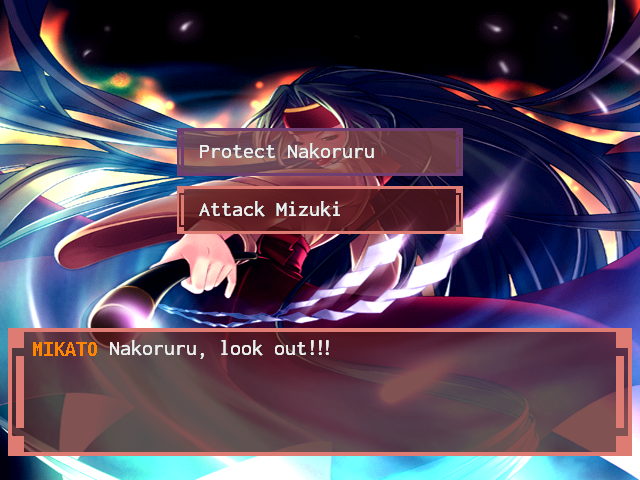
Mikato meets Nakoruru for the first time.

The game’s story is told from the perspective of seven-year-old Mikato, an orphan who is taken in by the people of the snowy village Kamui Kotan. She is selected by the village's chief to serve as assistant to the shrine maiden Nakoruru, somebody the people of Kamui Kotan admire for her strength, dependability, and outward positivity. Mikato soon realises, however, that deep down, Nakoruru is harbouring an intense sorrow. 

While Nakoruru is based in the world of Samurai Shodown, it can be played without any prior knowledge of the franchise, but if you are a Shodown fan, there are quite a few playful references to other characters in the franchise sprinkled throughout the game's script.

Nakoruru's childhood friends Yantamu and Manari.

The gameplay of Nakoruru is simple, and familiar to those who have played a visual novel before. Advance the story with a button press, and occasionally make choices, some of which greatly affect the game’s narrative.

Also included throughout the story are several basic but charming mini-games. These include quizzes, fishing, dodging enemy attacks, playing music, and more. 

While Nakoruru may lack the 3D graphics and arcade action many associate with the Dreamcast, it still boasts gorgeous, crisp, hand-drawn 2D artwork, and its beautiful coming-of-age storyline will pull at your heart strings as it deals with topics of friendship, loss and insecurity. The Dreamcast received over 100 visual novel titles in Japan, and in terms of quality, Nakoruru is up there with the best the system has to offer. For those new to the visual novel genre, you can learn more about them in this fantastic video by Bowl of Lentils.

Combat training mini-game where you dodge left or right to escape attacks.

We adopted an assembly line process to translate the game’s script. First, dialogue for an individual scene would be translated by Marshal and Duralumin, then the editors - both myself and Derek, would check over the translations for any spelling or grammatical errors, but primarily to ensure they read as naturally as possible in English. Once the script edits were complete, Derek would insert them back into the game. Working together and seeing the story come to life, and by our own making, was incredibly rewarding. 

Making an important decision in the heat of combat.  
But our translation would have been for nothing if it wasn’t for Derek’s hacking wizardry. The Dreamcast is still in an immature state when it comes to debugging and hacking, unlike other systems, such as PlayStation, which is more streamlined. A project like this for the Dreamcast required a slew of different tools to achieve. Along the way, Derek had to make many tweaks to the game so it worked with our translation, such as modifying mini-games, ensuring the character’s voice audio persisted across multiple textboxes, reallocating where RAM data was written to make room for larger text data, and more. But the biggest challenge Derek faced was implementing a half-width font (as Japanese characters are wider than English ones), which took him months, but felt incredible when he finally pulled it off. The end result of Derek's hard work is fantastic-looking English text displayed in game.

An English Fan Translation of Cool Cool Toon is in the works!

SNK's Japanese-exclusive rhythm romp Cool Cool Toon has long been considered a top title for gamers looking for import-friendly Dreamcast games, not only due to how accessible its gameplay is, but also because of how fun and colourful its crazy-looking characters and cel-shaded aesthetics are.

Despite all this, if you're looking to make much sense of the story and can't speak Japanese... well, you're splat out of luck. I guess you could use that Google Translate app, but that's immersion breaking, dammit! Phew. Anyway, Derek Pascarella, who previously brought us English fan translations of Sakura Wars Columns 2 and Rainbow Cotton (along with many others), has announced today that he has an English fan translation patch in the works for Cool Cool Toon.

Also joining Derek on his translation journey is Cargodin (whose previous work on Dreamcast includes the excellent Napple Tale: Arsia in Daydream fan translation) and Popomocco. Along with this announcement, Derek has posted some early work-in-progress footage to his YouTube channel, which you can watch below.

To keep track of this project as it progresses, you can follow Derek on Twitter, or keep an eye on the project's Dreamcast Talk forum thread.

Have you played Cool Cool Toon before and are excited for this translation to be released? Let us know in the comments below on our social media pages!

Two Dreamcast shooters now playable in English!

We're not even a week into 2022 and we've already received not one, but two English fan translations of Japanese Dreamcast games! This community sure works at a rapid pace. Both of the games are vertically scrolling shooters, or 'shmups,' as the cool kids like to say. Let's check ‘em out...

First up is Radirgy, which was originally developed by MileStone, Inc. for the Sega NAOMI arcade platform. It was eventually ported over to the Dreamcast in 2006, exclusively in Japan, years after the West presumed the rest of the world had given up on Sega's swan song console. Radirgy replaces the usually dark, space theming of other shoot-em-ups with a colourful, cel-shaded anime style. With gameplay that verges on bullet hell, and a protagonist that is allergic to radio waves, this one is about as Japanese as they come. Even the box art is slightly odd, simply opting to feature said protagonist pushing her glasses up her nose in that cool way anime people do (should probably go to your local optician and get those adjusted, bud). Check out our Radirgy retrospective here.

An English translation of Radirgy appeared seemingly out of nowhere on the 2nd of January, submitted to RomHacking.net by user wiredcrackpot. The translation is based on the official US Wii release of the game, which wiredcrackpot admits isn't the best translation ever, but it's at least something that can serve to help us non-Japanese speakers understand the bonkers story that is taking place. 
You can download the translation patch at RomHacking.net. If you can't be bothered with all that patching stuff, though, you can simply go to the Dreamcast-Talk thread, where you will find an already patched .CDI and .GDI available for download. Burn the game onto a CD-R or throw it on to your GDEMU. Whatever you do, take a moment to speculate what drugs the people over at MileStone were taking when they made Radirgy. We'll have a debate about it next time we talk.

If you are also interested in playing an English translation of Radirgy's darker kind-of sequel, Karous, head here to download that.

Next up is Chaos Field, which was the first game ever developed by MileStone Inc. and was released in 2004 for the Sega NAOMI, with a Dreamcast release following a few months later. Perhaps a more standard shmup affair compared to Radirgy (stylistically, at least), the game consists entirely of boss battles, and has a pretty unique mechanic in which players can flip the environment at will between two parallel worlds. 

The Chaos Field translation patch was created by Derek Pascarella, whose work we've previously featured on the Junkyard (multiple times, in fact) and has also appeared on an episode of the Dreampod (check that out here). Inspired by wiredcrackpot's Radirgy patch, Derek started poking around in the code of Chaos Field to find the game actually shipped with about 80% of the text and images already translated into English - it had just been hidden away in the game’s code this entire time! Derek then translated the remaining 20%, and voilà! We now have Chaos Field completely in English, for the first time on Dreamcast.

You can download Derek's patch by going to this project’s GitHub repository. Patched CDIs and GDIs are available from the Dreamcast-Talk thread.
These projects are a good start to what is hopefully another big year for the Dreamcast community. Have you played any of these shooters before? Are you excited to play them in English? Let us know in the comments below, or by sounding off on our various social media channels.