Showing posts sorted by relevance for query insert. Sort by date Show all posts

Shenmue Bomber Jackets Now Available

Veteran games merchandise store Insert Coin has launched a new Shenmue-related product, and fans of Ryo Hazuki's adventures are likely to be lapping it up in droves. If you've already used your eyes to look at the images below, you'll no doubt be able to tell that it's a bomber jacket fashioned after the attire sported by Ryo as he traverses the back streets of Dobuita and Hong Kong in Yu Suzuki's as-yet-unfinished magnum opus.
In this day and age it's all too easy to just froth about anything Dreamcast related, but I'm going to give my honest opinion here: I think this jacket looks bloody awful.

It appears to be made of bargain-basement nylon and while the patches on the chest and arm are embroidered, the one on the back is screen printed. I suppose this is to be expected of a jacket that costs £60, but that doesn't explain why the colours are way off the mark. Yes, Ryo's jacket was leather in the game and leather replicas do exist...but this is just a cynical example of big businesses churning out shite to fleece (heh!) fans of a franchise. Again, I've got nothing against Insert Coin - they do some really top quality stuff and I own several t-shirts by them. But this Shenmue jacket is an affront to the Hazuki family name. Interestingly, Insert Coin did have a slightly more accurate Ryo Hazuki jacket for sale in the past (check it out here), but even that still looked a bit on the cheap side.

Check out the Shenmue bomber jacket here. If you must.

New Sega & Dreamcast Themed Clothing Lines From Insert Coin


Insert Coin have just unveiled their latest line of games related apparel, and Sega fans will no doubt be pretty excited to see that a few different well-known Dreamcast games are represented, as well as the iconic Dreamcast swirl itself (although only in PAL blue).
Crazy Taxi, Jet Set Radio and Space Channel 5 are all reflected in the officially licensed designs, along with some others from the Mega Drive era and the famous swirl. The t-shirts and hoodies are available to pre-order now, and prices start at £22. No word on when they'll be shipping just yet, but they look pretty decent, don't you think?

Find out more at Insert Coin here. Will you be purchasing any of these? Let us know in the comments.

Insert Coin launches new Shenmue range

It may be the 20th year since the Dreamcast launch. However 2018 is proving to be one of the most bountiful years for merchandise and Dreamcast related gear. The launch of the official Sega shop in Europe bought with it a host of DC related goodies, and this has now been complimented with an additional collection from UK designers Insert Coin.

No strangers to either Sega or Shenmue wear itself, having previously released Shenmue branded t-shirts and coats in the past. The new range comprises a Ryo inspired Leather coat, as well as a themed hooded zip up coat, before finally being rounded out by a classic looking white Tee emblazoned with the Shenmue tiger on the back. The coats both look perfect for avenging your fathers murder in, keeping warm in the British drizzle or for just generally showing your nerdy Sega fanboyism as you strut about your retro gaming life, no doubt filming yourself reacting to all and sundry.

Check out the images below and let us know what you think in the comments. And check out the range on Insert Coin here, as well as their other Dreamcast range that Tom previously spotlighted here.


Review: Andro Dunos

I did consider labelling this post as a 'retrospective' as opposed to a 'review,' and that's because Andro Dunos is not a new game for the Dreamcast. It's not a new game, period. Indeed, this latest release physical for the venerable old console represents something of an enigma in that it's an officially sanctioned release of a game that was previously released a long time ago in an unofficial guise. Are you confused yet? I know I am. But allow me to attempt to unpack this little conundrum.

See, Andro Dunos is a Visco developed side (and occasionally vertical) scrolling shooter that was originally released for the Neo-Geo AES and MVS platforms back in 1992, and which was subsequently made available for the Dreamcast using the Neo4All emulator in the mid 2000s. Indeed, you may have even seen (or possibly own) a copy of the lesser-spotted physical release of Andro Dunos that was previously available, which was essentially a printed CD-R containing Neo4All and an Andro Dunos rom file, presented in a rather nice folded cardboard sleeve. There was a similar Neo Drift Out release too, if memory serves (found them!)...but I digress.

As far as I can tell, this latest iteration of Andro Dunos for Dreamcast is almost identical to the aforementioned (it even displays the Neo4All icon on the VMU screen), albeit with a few subtle differences; the main one being that this is an officially sanctioned physical release with full license from Visco Games and limited to just 2000 copies, all of which come with a rather nice certificate of authenticity and a choice of PAL or NTSC jewel cases, professionally printed manual and case inlays, and the same type of top quality printed CD that you would expect from veteran Dreamcast publishers JoshProd and PixelHeart.

Just taking a moment to appreciate the physical presentation of Andro Dunos (I went for the PAL cased version as the NTSC flavours are not yet - at the time of writing - available), it's really quite hard to fault the level of care that has gone into the package. As mentioned above, you get a nice (if slightly threadbare) instruction manual, some excellent original box art, a little holographic sticker on the back of the box denoting which of the 2000 numbered copies you have acquired (mine is 0332 - what's yours?), and then there's a signed cardboard insert vouching for the authenticity of the copy in your possession. It's a nice touch, I must admit.

But what of the game Andro Dunos itself? Well, it's a pretty bare bones affair in all truth. Set against the backdrop of an alien invasion of Earth, players are thrust into the cockpit of the Yellow Cherry fighter ship and tasked with battling through 8 levels of increasingly more difficult enemies, many of whom seemingly only exist to waft onto the screen, fire a shot and then either exit or propel themselves at your ship, kamikaze style. Naturally, you are armed with a complement of weapons systems which are actually quite similar to those seen in Sturmwind, and these are used to blast your way through the unending swarms of baddies and the numerous multi-staged end of level bosses.

I never played the original Andro Dunos back in 1992, simply because I didn't own a Neo-Geo. I did have a school friend who professed to own one of SNK's mythical systems, but when I went to his house to see/play on it, he claimed his mother had thrown it in the bin because - and I quote - "she didn't know what it was." Because that's something that happens in reality, Chris. You know who you are. 

The upshot of these blatant school boy lies, is that the Dreamcast release of Andro Dunos is my first real experience playing it, and when compared to the other shooters available on the platform, it leaves me a little cold.

Dream Color Plus — New Controller Mod Turns the Sega Dreamcast's VMU Screen Full Colour

Dream Color Plus being tested with Resident Evil: Code Veronica. Credit: Costenaro

There's been a lot of buzz within the Dreamcast fan community as of late over Dream Color Plus, a new controller mod from Brazil-based developer Nai Adventure, which converts your controller to show VMU graphics in full colour, as opposed to its typical monochrome display. The idea with the mod is that by taking apart an existing Dreamcast controller, and removing the existing PCB, you can pop the Dream Color Plus in, and voilà, you now have a wireless Dreamcast controller that has a built-in, backlit VMU screen that displays in full colour. The mod will also include on-board save game storage. You can watch the mod in action below. It's looking very impressive indeed...

Many of our followers have been tagging us under social media posts about the Dream Color Plus in the past week — don't worry, we've been paying attention, and since a crowdfunding campaign has been confirmed, we thought it was time we spoke with the dev to get the lowdown on this exciting project.

DCJY: Nai Adventure, thanks for chatting with us. The Dream Color Plus project looks awesome — it’s wild to see VMU graphics of games we’ve been playing for decades suddenly brought to life in full colour. Can you explain how it all works? And with such a huge library of Dreamcast games, how do you plan on colouring every VMU graphic?

Nai Adventure: The controller has three modes:

  • Monochrome, like the original Dreamcast. 
  • Palette mode, [which is] similar to what the Super Game Boy does with Game Boy games. To switch palettes, you hold the analog stick (which works as a new button) and press A to change line colors, B to change background colors, and the start button to invert them (like a photo negative). Here’s a quick demo: 

  • Full color mode: for new games, devs can send pixel-by-pixel colors directly to the controller (I’m preparing some sample code for that). For older games, the process is more manual. We capture the frames that the games send to the VMU, color them, and whenever the VMU calls for that frame, the controller swaps it.

It sounds crazy, but we already have a good list of games converted. Of course, coloring the whole Dreamcast library is almost impossible, but the main games will get full color support. Since the PCB has an SD card slot, new games can be added little by little over time.

Left: Dream Color Plus showing off a coloured-version of the Sonic Adventure 2 VMU graphic.
Right: The Dream Color Plus PCB.

Sounds great! So is swapping the stock Dreamcast controller board out for the Dream Color Plus easy?

Yes! The whole idea is for it to be plug and play. You just open the controller and replace the PCB. That’s actually why we didn’t make a version with a second analog stick (something people ask for a lot). If we can get a partner to make new shells in the future, then a dual-stick version would totally be possible.

That potential dual-stick mod is something the community would go crazy for, I'm certain. So, with the Dream Color Plus, as it is effectively a VMU built into the controller, how much storage for saving can we expect to see?

Right now we’ve got eight VMU pages by default, but that number can be changed with a config file on the SD card. The controller also comes with built-in rumble. You lose the external VMU slots, but the main features are all there.

The Dreamcast Legacy - BlazBlue: Cross Tag Battle

In a new series of articles (perhaps only a short-lived series, as I only have this and one other lined up), we will be exploring modern games that owe a debt to the blazing trails left by the games and developers of the bygone Dreamcast era. In this issue, we will be looking at the upcoming Arc System Works title BlazBlue: Cross Tag Battle, a new 2 vs. 2 tag-team fighting game coming soon to PS4, Switch, and Steam. Apart from the obvious correlations with similar Dreamcast heavyweight titles such as Marvel vs. Capcom 2 and the Capcom vs. SNK series, this new crossover beat-'em up shares a little more Dreamcast heritage than you may initially realise.


Dreamcast Remake?

You know Tectoy? It's the Brazilian toy company that sometimes makes Sega stuff.

They has something interesting on their website.

http://www.tectoy.com.br/

Basically it's a sort of poll that asks which console people would want them to remake. Oh course they are not saying that they *are* going to remake the console that is chosen but...


(I miss Photoshop)
Here are the stats:

Game Gear (5.3%)
Dreamcast (91.0%)
Pense Bem (3.7%)

I think this is VERY interesting. Normally Tectoy seems to like to shrink consoles down and put a ton of games on them via flash memory. Could they do something like this for the Dreamcast??? Is it technically possible? Of course I suppose it could be. Is it financially viable to do this? That I am not sure of...

Still we can all dream. It would be nice if they could somehow remake the Dreamcast. However, is there really any point? How can you really improve on the Dreamcast? I suppose if they do something radical like wireless controllers or a built in screen or pre-load it with rare games...

In any case keep an eye out.

Pulled from DC Emu UK:
http://dreamcast.dcemu.co.uk/tectoy-dreamcast-possible-111395.html


Original article Insert Credit:
http://www.insertcredit.com/archives/002325.html

The Dreamcast Suitcase

Thanks to a tweet by fellow Dreamcast site Dreamcast Gaga, we have been alerted to the existence of a previously unknown item of DC memorabilia. Now, we've all seen the Insert Coin shoulder bag, and the Kawaii back-pack styled in the form of a Dreamcast controller...but what about a wheeled suitcase modelled after our favourite system? It looks like it's only available to Japanese Dreamcast nuts for now, and can be purchased from the Ebten Sega Store website, but I absolutely guaran-damn-tee you would be the coolest person in the terminal if you rocked through Heathrow pulling this bad boy...

Edit: it has been brought to my attention that the case was only availible for 1 day back in March 2013...so unless you have access to a DeLorean with an aftermarket Flux Capacitor fitted, you'll just have to make do with drooling at these images!

A Quick Look at Dolphin Blue

Just like our previous article exploring the history of the Sega Driving Simulator, this began as a sub-section of the upcoming part 4 in our 'Expanding the Dreamcast Collection' series regarding the next in the line of arcade systems to share similar hardware to the Dreamcast; the Atomiswave system. People often ask me…wait - who am kidding…let me start again. In my imagination, people often ask me to name the 'exclusive killer app' for each of the systems in the Dreamcast family and I usually struggle, but with Atomiswave, an answer is easy to produce; not only is this the best Atomiswave game, but this could well very be the single best exclusive across the entire Dreamcast family of arcade hardware. Read on to find out more.

I’m a big fan of Metal Slug but like many of you out there, I found the series got a wee bit stale after the third game. Not to say that subsequent games were bad or anything, just that…well, I couldn’t shake the feeling of déjà vu, and have always preferred the purity of the original game without all the zombies, mummies, aliens and transformation nonsense. Dolphin Blue fills the void left in the wake of the Metal Slug series’ change in direction, and then some.
Even before merging with Sega, Sammy had a close relationship with Sega.
Atomiswave and the Guilty Gear series are heavily associated with both companies. 
The game was one of the last Sammy developed before the merger with Sega in 2004. Despite this, it feels incredibly Sega-like for lack of a better term; blue skies, upbeat catchy tunes, cute spunky characters with plenty of 'tude and even an appearance from Sega’s very own Ecco the Dolphin…Ok, well that last part I may have just pulled out of my arse, but many of the gameplay mechanics do revolve around a certain bad ass cetacean chum.

Nakoruru: The Gift She Gave Me - Samurai Shodown Spin-Off for Dreamcast Translated into English!

After nearly two years of hard work, I am absolutely elated to inform you that a team consisting of Derek Pascarella, Duralumin, Marshal Wong and myself have completed our English translation of Nakoruru: Ano Hito kara no Okurimono for the Sega Dreamcast, and today you will be able to play it.

Being a fan favourite character of SNK’s beloved Samurai Shodown fighting franchise (known as Samurai Spirits in Japan), it’s only natural that Nakoruru would get her own spin-off game. SNK granted developer Inter-Let's the privilege of crafting a story that explored her character in finer detail, with the result being Nakoruru: The Gift She Gave Me (as we’ve decided to dub it), a Japan-exclusive visual novel game released for Windows in 2001, with an improved Dreamcast version releasing a year later in 2002. To take a source material known for its intense arcade fighting thrills and adapt it into a quiet, heartfelt text-based adventure was definitely intriguing, so much so that it made us want to produce an English translation almost two decades later! 

To translate the game into English was no small feat, however. With over 12,000 lines of text, our translation of Nakoruru was going to take us more than a year to produce. But it honestly feels like that time has flown by, because the more we worked on translating the scripts, the more we fell in love with the game's plot and characters.

Mikato meets Nakoruru for the first time.

The game’s story is told from the perspective of seven-year-old Mikato, an orphan who is taken in by the people of the snowy village Kamui Kotan. She is selected by the village's chief to serve as assistant to the shrine maiden Nakoruru, somebody the people of Kamui Kotan admire for her strength, dependability, and outward positivity. Mikato soon realises, however, that deep down, Nakoruru is harbouring an intense sorrow. 

While Nakoruru is based in the world of Samurai Shodown, it can be played without any prior knowledge of the franchise, but if you are a Shodown fan, there are quite a few playful references to other characters in the franchise sprinkled throughout the game's script.

Nakoruru's childhood friends Yantamu and Manari.

The gameplay of Nakoruru is simple, and familiar to those who have played a visual novel before. Advance the story with a button press, and occasionally make choices, some of which greatly affect the game’s narrative.

Also included throughout the story are several basic but charming mini-games. These include quizzes, fishing, dodging enemy attacks, playing music, and more. 

While Nakoruru may lack the 3D graphics and arcade action many associate with the Dreamcast, it still boasts gorgeous, crisp, hand-drawn 2D artwork, and its beautiful coming-of-age storyline will pull at your heart strings as it deals with topics of friendship, loss and insecurity. The Dreamcast received over 100 visual novel titles in Japan, and in terms of quality, Nakoruru is up there with the best the system has to offer. For those new to the visual novel genre, you can learn more about them in this fantastic video by Bowl of Lentils.

Combat training mini-game where you dodge left or right to escape attacks.

We adopted an assembly line process to translate the game’s script. First, dialogue for an individual scene would be translated by Marshal and Duralumin, then the editors - both myself and Derek, would check over the translations for any spelling or grammatical errors, but primarily to ensure they read as naturally as possible in English. Once the script edits were complete, Derek would insert them back into the game. Working together and seeing the story come to life, and by our own making, was incredibly rewarding. 

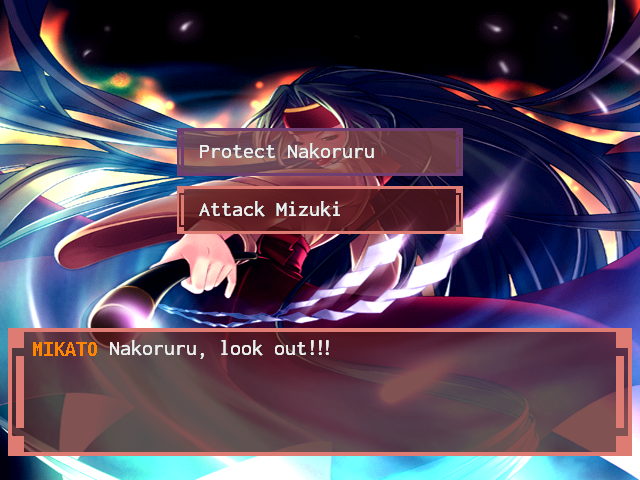
Making an important decision in the heat of combat.  
But our translation would have been for nothing if it wasn’t for Derek’s hacking wizardry. The Dreamcast is still in an immature state when it comes to debugging and hacking, unlike other systems, such as PlayStation, which is more streamlined. A project like this for the Dreamcast required a slew of different tools to achieve. Along the way, Derek had to make many tweaks to the game so it worked with our translation, such as modifying mini-games, ensuring the character’s voice audio persisted across multiple textboxes, reallocating where RAM data was written to make room for larger text data, and more. But the biggest challenge Derek faced was implementing a half-width font (as Japanese characters are wider than English ones), which took him months, but felt incredible when he finally pulled it off. The end result of Derek's hard work is fantastic-looking English text displayed in game.

AGES II: Sega Game Archives Music Arrange Album

When is a Dreamcast game not a Dreamcast game? Why, when it's a music CD of course! AGES II from Japanese studio Woodsoft is just that - it's a music CD full of re-imagined music tracks from classic Sega titles of yesteryear, delivered in a package that looks very similar to a legitimate NTSC-J Dreamcast game case. Released at the tail end of 2014, this is actually the third in a trilogy of compilations under the AGES brand from Woodsoft, and before acquiring this CD from an eBay seller located in Japan, I was totally oblivious to the existence of such a collection. And while it isn't strictly Dreamcast related, I think the intriguing packaging and subject matter make AGES II a perfect subject for a minor investigation here at the Junkyard.
When I first saw AGES II listed on eBay, it caught my attention because I wasn't aware of a Sega Ages collection ever being released for the Dreamcast. Obviously, we have stuff like Yu Suzuki Game Works, but a proper entry in the Sega Ages series never actually came to the Dreamcast and it is that fact which initially drew my eye to it. Upon closer inspection (the description wasn't overly clear on what it was), I discovered that the Dreamcast logo shown in the photos was back to front, and it doesn't say Dreamcast - it says 'Dreamnalt.' AGES II represented something of an intriguing mystery to me, and so off I went to Google to get more information on this Dreamnalt outfit...only to find, well, very little to be honest.
If you search AGES II or Dreamnalt, Google doesn't really produce anything other than a few images from an old Tumblr account and it was only by changing the search terms several times that I came across this review over at Hardcore Gaming 101. It's a review of the first AGES collection which features music from such legendary games as Power Drift, Lunar and Fantasy Zone. From that article, I discovered that Woodsoft have several more CDs listed on the Video Game Music Database (VGMdb), which is a repository of information similar to IMDB but solely for the collection of resources pertaining to music used in games.

The Dreamcast Rucksack

Very recently we inducted the excellent Dreamcast messenger bag into the 'Yard. No, not the new Insert Coin pretender - the original Sega Europe messenger bag that was sent around to various retail outlets in 1999 as part of the promotional activity surrounding the system's launch. There was another item of wearable luggage created to promote the Dreamcast though - the Dreamcast-branded rucksack. That description probably isn't technically correct as the 'rucksack' only has one strap that goes across the wearer's body, but it's not a satchel or messenger bag in the traditional sense, so I guess we'll have to stick to our guns with the description. Enough words though - thanks to the planet-destroying power of the BlackBerry Q5's amazing camera, here are some extraordinarily high resolution pictures:

Hardware Review: GD-ROM & Compact Flash Modded Dreamcast

Technology fails. It's as simple as that. With the passage of time, and daily wear and tear, eventually even the most robust equipment will suffer a breakdown. We can do plenty to prevent this atrophy, but inevitably, anything that employs moving parts will break. As Dreamcast owners, we're probably all too aware of the various failures that can besiege our favourite console, and the list of potential faults is long. Power boards, main boards, controller boards...pretty much everything in a Dreamcast is prone to the ravages of time, and public enemy number one is undoubtedly the GD-ROM drive. More than any other component as the Dreamcast rapidly approaches its twentieth anniversary, the main, bespoke optical drive that is a key component to enjoying those brightly hued games of yore is becoming a weak link. Raise your hand if you've ever put a game in a Dreamcast only to be met with the dreaded 'please insert game disc' message.
The catalyst for many a clenched fist and jaw
To remedy this, there are several devices on the market that allow users to negate the need for a GD-ROM drive; and in many cases they allow for the complete surgical removal of the optical drive in favour of solid state storage for games and other applications. The two most popular variants currently available are the GDEMU and the USB-GDROM.
GDEMU
USB-GDROM
These two devices require complete removal of a Dreamcast's optical drive and offer the option of using either an SD card or USB flash drive respectively from which to boot Dreamcast ISO files. There are also further alternatives that employ the use of a traditional hard drive, but these are not as popular or widespread as either of the two options mentioned above.
Internal HDD mod (courtesy of Pcwzrd)
Both GDEMU and USB-GDROM are great alternatives to the ailing GD-ROM drive - with both offering minimal loading times and enhanced curation of game files. Both also employ proprietary software for operation and boast almost 100% compatibility with games in the Dreamcast library. With the Compact Flash and other alternatives, DreamShell (the open source OS created by DC-SWAT) is employed, and while this benefits from being customisable, it doesn't offer the near full compatibiltiy enjoyed by GDEMU and USB-GDROM. That said, DreamShell is in a constant state of flux, with new updates always being worked on, so in the future full library compatibility is more than possible. In the meantime, here's a handy list of Dreamcast games that will work with DreamShell, courtesy of Pcwzrd of Dreamcast Live fame. The crux of the matter is this though: all of the other options for eschewing optical media listed here require the removal of the GD-ROM drive.
So, what to do? How can you have the best of both worlds? The solution is combining the convenience and enhancements that come with solid state storage, with the ability to still use a standard game GD (or CD) if the need arises. Enter the latest modification on the market that hits both these targets with quite some accuracy: the Compact Flash Dreamcast. Coming from Austrian modder Jan, this Dreamcast keeps the standard GD-ROM drive intact and perfectly functional, but also adds a fairly discreet CF card slot on the right hand side and a BIOS switch on the rear. This switch allows for the console to be booted in either 'standard' mode where the console is just a normal retail unit able to read disc-based games; or to be booted in DreamShell mode, where the CF card is interrogated and any game files on the card are presented in a rather nice menu using aesthetically appealing icons. There's plenty of other functionality too, but first, let's take a look at the hardware and just why Jan chose to use Compact Flash in this modification...

8BitMods' BitLink DC Kit Promises to Make Wireless Dreamcast Gaming a Breeze

With Sega never providing a wireless control solution for the Dreamcast themselves, the task of creating one has fallen on aftermarket companies and fans alike. There's a load of options out there: you've got controller options like Chris Daioglou's DreamConn — arguably the best solution overall, though it comes at a higher price point. Chris even created a wireless Dreamcast keyboard, in the form of the KeyConn. A more affordable alternative controller-wise is the StrikerDC Wireless from Retro Fighters, which has had been praised by those who have used it, but has compatibility issues with Dreamcast games that utilise Windows CE, and potentially corrupts saves when used with the VMUPro. If you’d prefer to use a different wireless controller altogether, or maybe a keyboard you have lying around, several adapters are available. These include the now hard-to-find Brook Wingman SD, BlueRetro adapters, and plenty of others, giving players more flexibility when it comes to wireless control methods for the Dreamcast (we know you lot love to tell everyone how much you hate the Dreamcast's original controller!)

8BitMods, the creators of the VMUPro, are throwing their collective hats into the ring with the BitLink, a new method that looks to give Dreamcast gamers the best of both worlds: not only by turning your existing stock Dreamcast controller into a wireless wonder through some easy modification, but also giving the option of allowing other controllers —both wired and wireless— to connect to the console.

The BitLink comes in two colours, classic white and smoke black, and consists of two parts. The larger piece, the "adapter," resembles a Dreamcast rumble pack, and slots into the second slot of your Dreamcast controller. To install it, you need to disassemble your controller and connect it via the "included cable to the controller's internal JST port," with no soldering required. There has been some confusion about how the controller will look once modded, with many asking whether the unused cable will just be dangling out the bottom of the controller, or if there will just be a hole where it once was. Hopefully 8BitMods will clear up some of the confusion soon.

Once done, your controller becomes wireless, with rumble, on-board storage (four virtual flash memory cards worth), and a battery that will also charge your VMUPro if you insert into slot one. It supposedly will also have "motion control", and we're intrigued to see how that can be utilised...

The thing that makes this adapter talk with the system is the dongle (pictured below), which can also use Bluetooth and 2.4gHz to link up other wireless controllers, keyboards, and computer mice. To charge, simply plug a USB-C cable from the dongle into the adapter in your controller. The dongle’s USB-C port can also be used to connect up wired controllers and keyboards. It will also apparently connect to some kind of built-in web interface via Bluetooth, which will allow for controller customisation (some second stick action in Quake III Arena, maybe?)

8BitMods' product page suggests that this too will have its own built-in storage, which would make sense, as they are offering the dongle on its own at a cheaper price of £26.99, while the "kit" —which will include both the adapter and the dongle— is priced at £69.98.

If you want to learn more, check out the product pages by clicking here. Pre-orders go live this Friday at 6PM GMT / 1PM EST.

5 Dreamcast Fan Translations You May Have Missed

In DreamPod Episode 86, where we discussed what we'd like to see from the Dreamcast scene in 2021, I was quite vocal about my desire to see more English fan translation patches produced for Dreamcast games. If you're anything like me, you're too lazy to learn Japanese, but absolutely long to play many of the very intriguing text-heavy Japanese Dreamcast releases. I've covered the Evangelion typing tutor translation by Derek Pascarella, and James also wrote a great retrospective on Taxi 2, going over Derek’s patch for that, but today I wanted to shine the spotlight on some completed translation projects that we (perhaps criminally) haven't covered here on the blog before. 


Blue Submarine No. 6: -Time and Tide-

Blue Submarine No. 6 started out as a manga that was first published in 1967, with an OVA (essentially a straight-to-video anime) adaptation released in 2000. The story of BS6 is set in a post-apocalyptic future, where the sea levels have risen and flooded most of the land on Earth. What remains is being attacked by half-animal hybrids, which are fought back by humanity's submarine forces, including the titular Blue Submarine No. 6. Time and Tide was developed and published by Sega, and released in December 2000. 

This very cool game mixes some excellently-presented visual novel-style sections (that utilise cel-shaded animation to present the game's characters), with 3D underwater segments in the submarine that control really well. While this game is playable without knowing Japanese, it is vital to understanding the plot. Thankfully, over the space of year, a team comprising of Rolly, RafaGam, esperknight and Eyl put together an English translation patch for this awesome game, and released it at the tail-end of 2020, to celebrate the game's 20th anniversary, as well as the 22nd birthday of the Dreamcast console. 

All in-game text is now understandable to non-Japanese speakers, anime cutscenes now have English subtitles, and pesky spoken dialogue during submarine missions where the translators couldn't insert subtitles have been overdubbed with English text-to-speech voices. The Blue Submarine No. 6 -Tides of Time- website was also restored and translated into English as part of this project, allowing players to download the game's original DLC to grant bonus items in the shop. To download the patch, check out the project's page on SEGA-SKY.


Napple Tale: Arsia in Daydream

Developed by a largely female-orientated development team, Napple Tale released to Japan in October 2000, and was never brought over to the West for... some reason. This colourful adventure combines a 3D hub world with 2.5D platforming stages, complete with an absolutely terrific score by acclaimed composer Yoko Kanno. Similar to Blue Submarine No. 6, Napple Tale is perfectly playable without the need to know Japanese, but its whimsical, fairy-tale inspired story is definitely something worth experiencing. 

In October 2019, a team led by translator Cargodin released an English patch online, allowing non-Japanese speakers to experience Napple Tale's story 19 years after the game's initial release. The game's original website was also restored and translated into English, allowing the game's DLC to be downloaded, unlocking a bonus stage called "paffet rally". If you fancy a trip to Napple World in all its English-translated glory, you can download the patch at Romhacking.net.